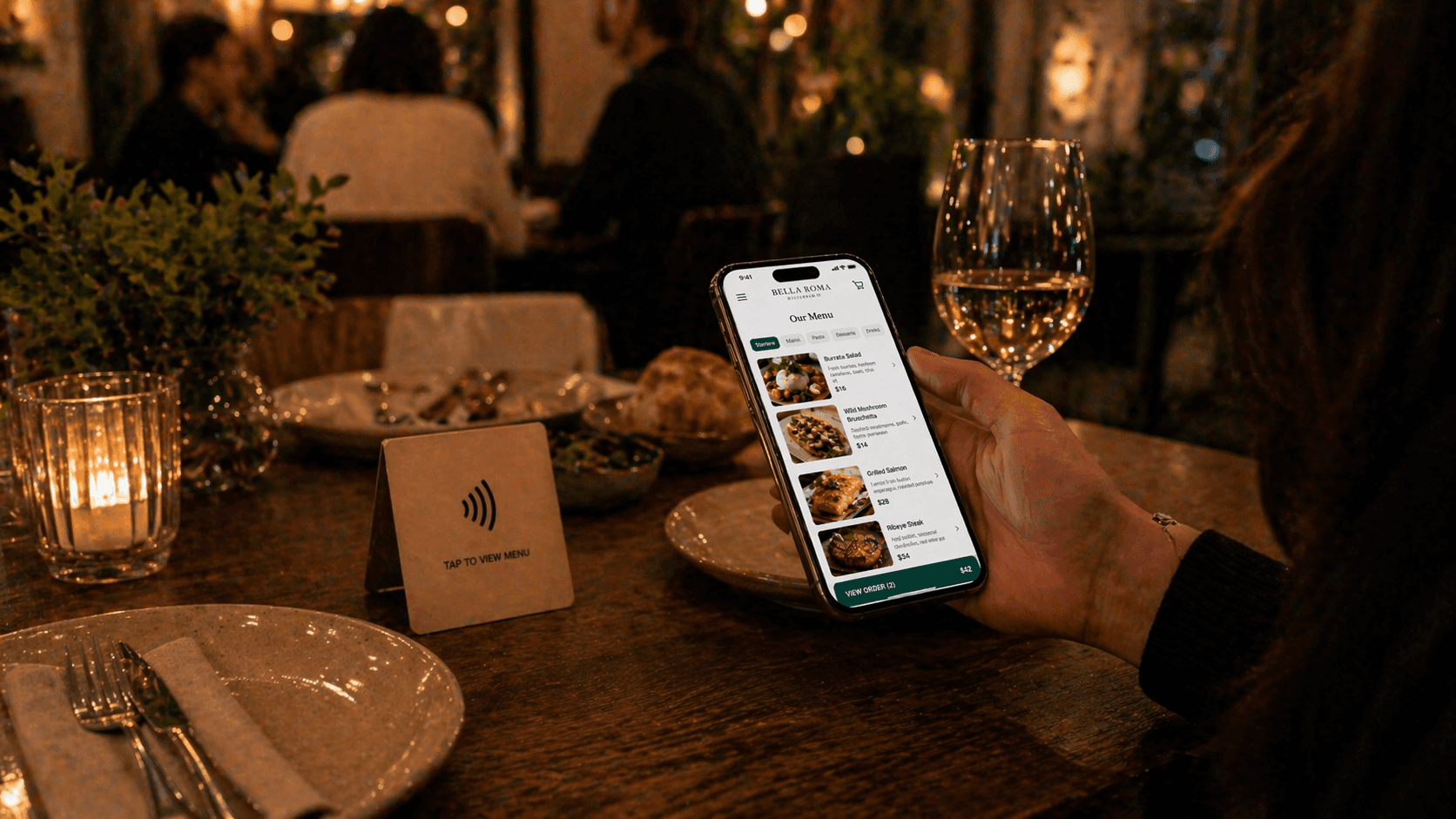
The 2020 push to contactless was about hygiene. The 2026 version is about speed, control, and privacy — guests have gotten used to reading the menu on their own terms, paying without handing over a card, and not filling out a form to look at a sandwich. The motivation changed; the expectation stayed. Here's what it looks like at the table now, and what venues that skipped the upgrade are losing.
The post-pandemic plateau
Most of the 2021-era predictions were wrong. QR menus didn't take over. Kiosks didn't replace servers. Ghost kitchens cooled. What stuck was quieter: a low-grade expectation that somepart of the meal — menu, payment, loyalty — should work without flagging down a server. That expectation doesn't show up in NPS scores, but it shows up in return visits.
2026 guest expectations
Three expectations are now essentially universal in full-service and QSR dining:
- Speed. Guests want to see the menu before a server reaches the table. Three seconds, not thirty.
- Choice. Digital or paper, self-serve or server-led — the guest picks, not the venue.
- Privacy. No required signup. No phone number to see a menu. No tracking without consent.
Venues that hit all three quietly delight. Venues that miss any one generate a specific, recognizable resentment — the kind that shows up in online reviews weeks later as “the experience felt off” without anyone able to pinpoint why.
5 features every restaurant should have this year
This list isn't aspirational. It's the 2026 baseline. Missing any one is noticeable:
1. A mobile-first digital menu that loads in under 2 seconds
On cellular, in a basement, on an older phone. Two seconds is the bar. If your menu is a PDF behind a QR code, you're below it — see how to create a digital menu that actually works for the upgrade path.
2. Tap-to-pay at the table
Mobile-wallet-first payment terminals are now cheaper than the card readers they replaced. Guests expect to pay without handing over a card.
3. Digital loyalty without forced app install
Web-based loyalty (SMS, email, or passkey) is the 2026 standard. The loyalty program that requires an app install to earn a point is the loyalty program nobody joins.
4. No forced account for the menu
Zero signups, zero fields, zero friction to read a menu. Any signup wall between a scan/tap and the menu will cut adoption by 40%+.
5. Data hygiene
Capture only what you'll act on. Be clear about what you're capturing. Make opt-out easy. Guests notice when a restaurant treats their data like a resource instead of a liability — and they reward it with return visits.
Tip
The fastest read on whether a restaurant hits the 2026 baseline: time the menu. If it takes more than five seconds from “I want the menu” to “I'm reading it,” something is below standard.
What guests quietly resent
These aren't rant-level complaints. They're quiet resentments — the kind that erode return intent without showing up in direct feedback:
- Intrusive app downloads. Any install-to-view feels predatory.
- Form walls. Name and email before the menu? No thank you.
- Paywalls on premium menus. “Unlock the full menu” is a marketing person's fantasy.
- Forced upsells. Modal ads for desserts before you've seen the mains.
- Stale pages. A price on the screen that doesn't match the printed menu erodes trust immediately.
Where NFC fits into the 2026 stack
NFC isn't “the next big thing.” It's the current standard for tap-based interaction at a physical surface — the replacement for what QR tried and partially failed to be. Restaurants adopting NFC in 2026 aren't early. They're on pace.
The stack looks roughly like this for a well-run independent:
- NFC tag at the table → primary menu and interaction surface
- QR code on the same card → universal fallback
- Hosted digital menu → fast, mobile-first, no forced signup
- Tap-to-pay terminal → checkout
- Web-based loyalty → opt-in after the meal, not before
- Review prompt → NFC or SMS, after payment
This isn't a complex stack. Most of it is invisible to the guest. That's the point.
Most of this stack can be assembled from separate vendors. Plenty of venues do that — POS from one company, payment terminal from another, menu software from a third, NFC from wherever. If you'd rather keep the tap layer (NFC, hosted menu, analytics) in one place, Tappflow is built for exactly that shape and deliberately stays out of POS and payments.
Predictions for 2027
What's likely in the next 18 months, if patterns hold:
- The “app or nothing” era ends quietly. Web-based passes, loyalty, and checkout will keep winning over forced installs.
- NFC will become the default, QR the fallback. Especially in new venues and refurbishments.
- Short-form AI summaries of menus will appear on big aggregators — restaurants will start formatting menu content to be scrape-friendly.
- “Data minimalism” will become a selling point. Expect some venues to advertise “we don't collect your data” as a trust signal.
- Guest expectations will keep tightening. The 2-second menu bar will become the 1-second menu bar.
The pattern worth noticing: tap-based, app-less, privacy-respecting, fast. Restaurants that commit to those four in 2026 will feel modern for the next five years. The ones that wait will feel dated — not in a charming way, in the way that tells a first-time guest you haven't updated anything in a while.
Frequently asked questions
Yes — but the motivation has shifted from hygiene to speed, control, and data. Guests now expect contactless access to menus, payment, and loyalty as a baseline, not a novelty.
In full-service dining, yes — the server is part of the experience. Contactless is strongest for pre-order (menu review), post-order (payment, loyalty, review), and edge cases (allergen info, split bills).
No. They'll keep their place as the fallback and the low-cost option. But expect the primary table interaction to shift toward NFC or app-less web flows over the next two to three years.
Forced account creation. Guests will scan, read, and even pay — but will bounce the moment a restaurant demands signup for something that should have taken one tap.
See Tappflow at work in your restaurant
NFC tags, a digital menu, and instant updates — built together so you never reprint a menu again.