Every restaurant owner who ran a QR menu through 2021–2023 has the same question in 2026: is NFC the upgrade it promised to be, or another trend that adds complexity for marginal gain? The honest answer depends on the kind of venue you run — but for most full-service restaurants, NFC has quietly crossed the line from “nice-to-have” to “default.” This guide breaks down the real trade-offs without the hype.
The short answer
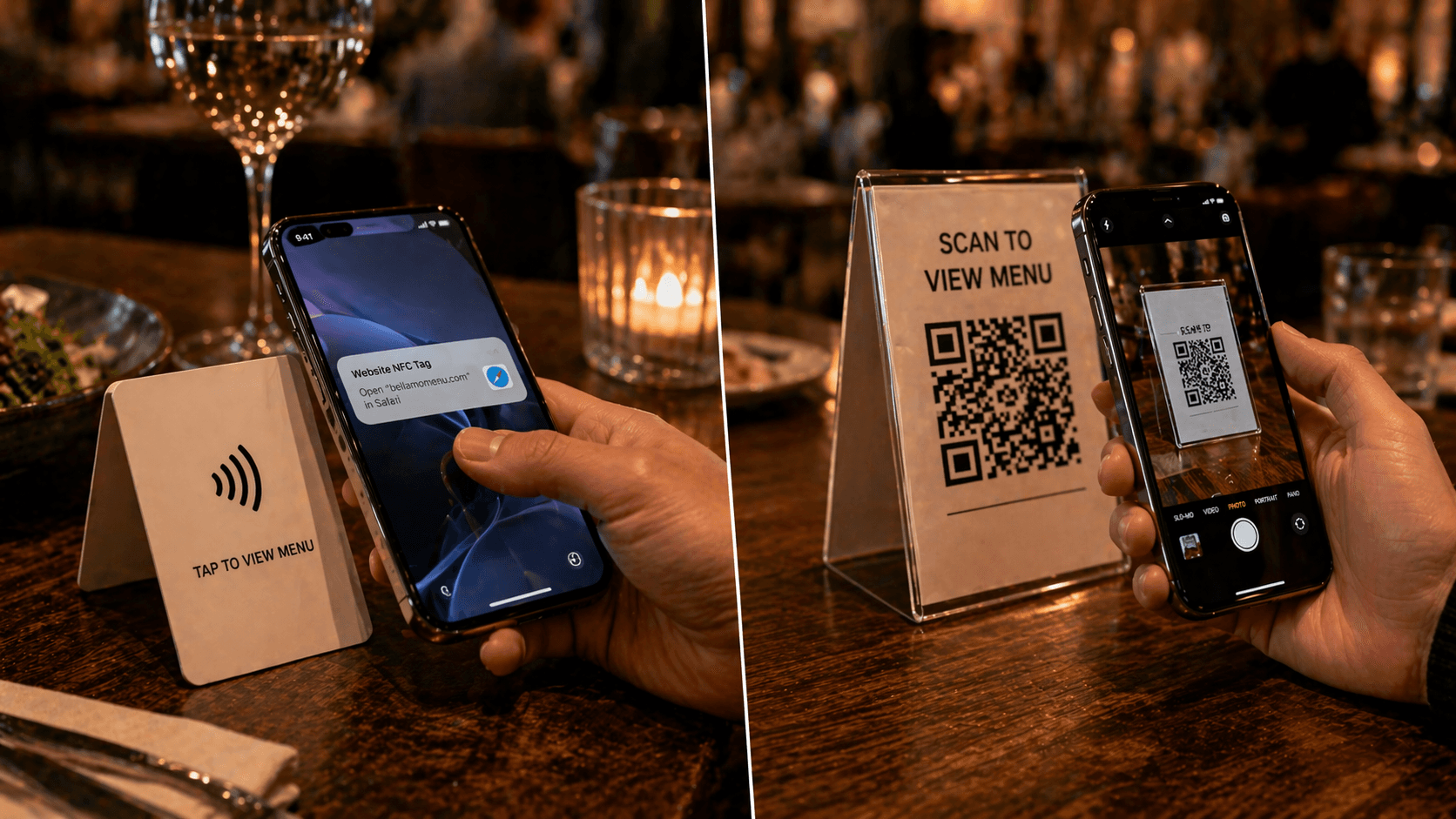
Use NFC for anything that lives at a fixed surface (tables, counters, menu holders, walls). Keep QR for one-off events, takeout bags, and as a fallback on the same card as the NFC tag. If you're running a full-service restaurant with return traffic, NFC will outperform QR on engagement in nearly every case — the friction math isn't close. If you run a pop-up that ships a different sticker every week, QR is still the cheapest choice.
How QR menus work
A printed image encoded with a URL. Open camera, aim, wait, tap notification, menu loads. Universal — every smartphone has a camera — and cents to produce. The catch is the sequence: five steps between “I want the menu” and “the menu is on screen,” which is enough friction that adoption plateaus well below 100% even with a perfectly placed sticker.
How NFC tags work
A small chip in a sticker or card holds a URL. The guest brings their phone within a few centimeters; their phone reads the chip; a notification appears; one tap opens the menu. Modern iPhones (XS and newer) read NFC in the background with no app or permission, and Android has supported it natively for a decade.
The useful detail: the best NFC platforms encode each tag once with a permanent URL, then resolve the destination server-side. You change what the tag opens — menu, today's specials, a review page — from your dashboard, without ever touching the hardware. This matters more than most owners realize, because it means you can swap flows mid-service and roll back if guests don't engage.
Side-by-side comparison
The comparison most owners care about isn't “does it work?” — both do. It's where the cost and friction actually live.
| Criterion | QR code | NFC tag |
|---|---|---|
| Upfront cost per table | Cents (printed sticker) | Few dollars (tag + card) |
| Cost to update | Reprint every change | Zero — repoint from dashboard |
| Taps to reach menu | 4–6 (camera, aim, notification) | 1 (tap phone, tap notification) |
| Works in low light | Harder to aim | Same speed |
| Per-tag analytics | Only via URL parameters | Built-in on most platforms |
| Hygiene perception | 2020 stigma lingers | No shared surface needed |
| Fallback needed? | Typeable URL | QR on the same card |
| Works for older phones | Yes, universally | iPhone 7+ (2016), most Android |
When QR still makes sense
QR isn't dead and doesn't deserve to be. It's genuinely the right tool in a few scenarios:
- Takeout bags and delivery boxes. Printed once, tossed within a day — no reason to invest in a chip.
- Pop-ups and one-off events. Where the menu is temporary, QR is correct.
- Printed advertising. A flyer, a newspaper insert, a poster — QR is the only option.
- Backup on an NFC card. Guest phone won't cooperate? QR is the instant fallback.
When NFC is the clear winner
- Any fixed table or counter. The tag lives there. You rewrite its URL, not the sticker.
- Any venue with return traffic. Returning guests get the faster tap every visit.
- Any flow where you care about engagement. Per-tag analytics give you data QR can't.
- Any brand that wants to feel modern. The tap itself is a micro-delight that reads as premium.
If your QR adoption is below 30% of tables, the problem is often structural — seven specific reasons QR menus get ignored covers most of them. NFC fixes the top two automatically.
The hybrid approach
Put NFC and QR on the same table tent. NFC is primary; QR is the fallback for older phones and thick-cased handsets. If your NFC platform uses a stable URL per tag (Tappflow does — each tag is permanently encoded with tappflow.com/t/{tagId}, and destinations resolve server-side), the same link drives both the tap and the scan. One setup, both paths.
Short context copy earns more taps than any other lever. “Tap phone here for menu” above the NFC target and “or scan with camera” above the QR will cost you ten minutes and move your adoption numbers more than a bigger sticker ever will.
What we recommend
For a full-service independent in 2026, the working pattern is:
- NFC + QR hybrid cards on every table from day one.
- Printed menus kept behind the host stand for guests who ask.
- Two weeks of measurement: tap rate, dwell time, whether staff need to prompt guests.
- Iterate on placement and prompt copy, not on the code. Those move more than any hardware swap.
Once you're live, the under-used payoff is instant menu edits — 86'd items, daily specials, price changes without reprinting. See updating your menu without reprinting for the operational playbook.
Frequently asked questions
Every iPhone from the iPhone 7 onward (2016+) and virtually all Android phones from the last decade read NFC tags natively. iPhone XS and newer read tags in the background with no app open.
Per unit, an NFC tag costs a few dollars while a printed QR code costs cents. Over a one-year span, NFC is typically cheaper because you rewrite the same tag instead of reprinting QR stickers every menu change.
You use one tag per table so you can track engagement per table and deep-link guests to table-specific flows (order, call server, request check). The destination URL can be identical if you don't need per-table data.
Ship a QR code on the same tag or sticker as a fallback. Most tag platforms print both side-by-side so nobody is excluded.
Outdoor-rated NFC tags (IP67/IP68) work in rain, heat, and direct sun. Indoor tags are cheaper and work fine on tables, counters, and walls. Pick the rating that matches where the tag lives.
See Tappflow at work in your restaurant
NFC tags, a digital menu, and instant updates — built together so you never reprint a menu again.