The playbook below applies to any tools you run — POS, menu software, marketing stack, whatever. Where a specific tool makes a tactic easier to execute, we name it; Tappflow's restaurant platform happens to cover several of the steps in one place.
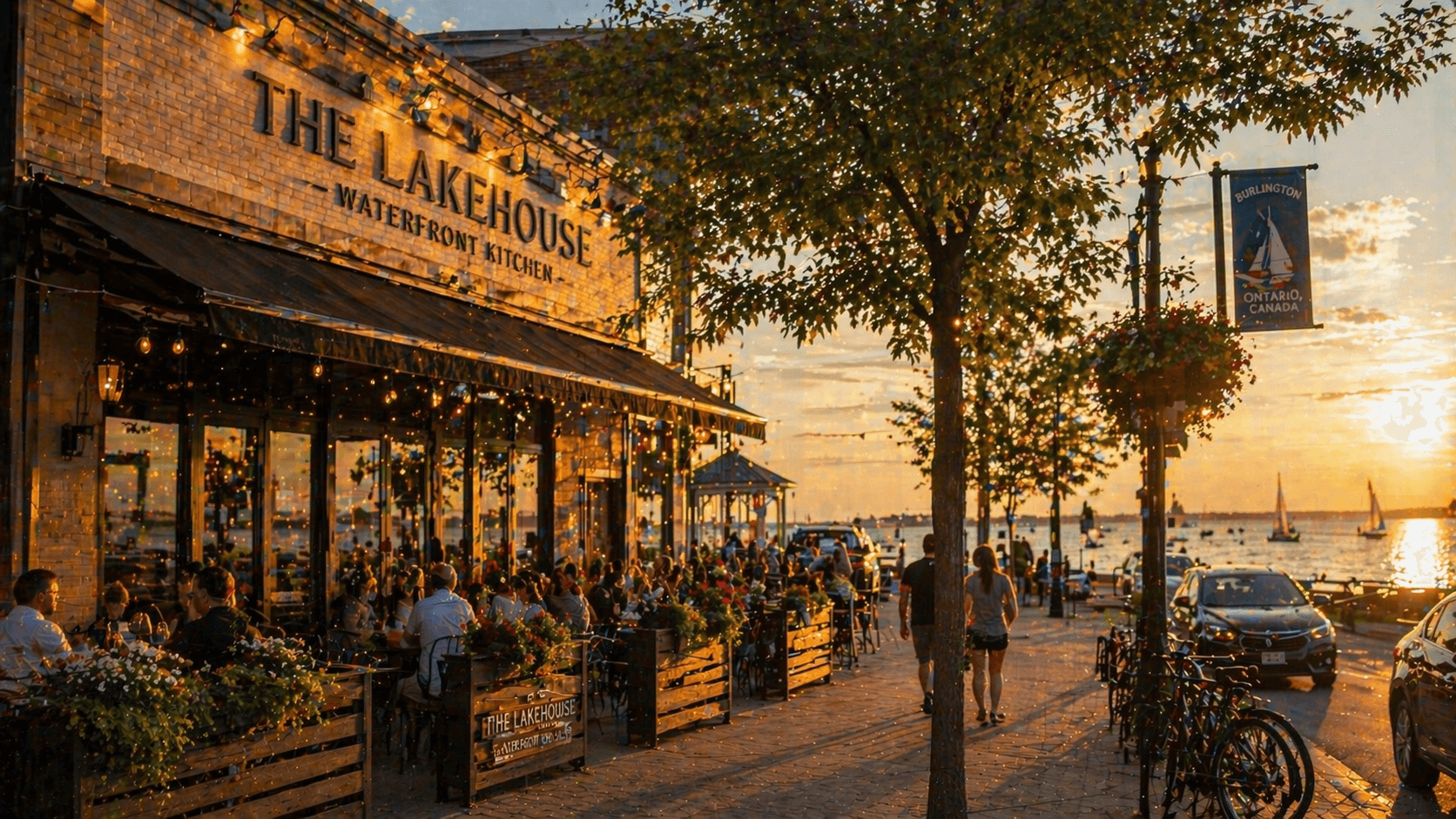
The Burlington restaurant landscape right now
Burlington's restaurant scene concentrates along Brant Street in downtown Burlington, the Spencer Smith Park waterfront, and pockets in Aldershot and Alton Village. Downtown Brant Street is the walkable core — pub-and-patio combinations, brunch cafes, wine bars, and a handful of destination dinner venues. The waterfront drives enormous summer foot traffic, with Spencer Smith Park hosting the Sound of Music Festival, Canada Day fireworks, and the Festival of Lights in winter. Aldershot is the older residential and retail corridor closer to the Hamilton border. Alton Village is the newer northern suburb with plaza-driven family casual dining. Burlington's proximity to Hamilton creates real cross-border traffic — game days at Tim Hortons Field and weekend Bayfront events pull Hamilton diners across the QEW. The chain presence is moderate (Joey's, Earls, Milestones downtown), leaving more room for indie operators than in Oakville.
Burlington's competitive picture is shaped by tourism and event-driven traffic more than by entrenched institutions. Downtown Brant Street restaurants compete on patio quality, festival positioning, and summer walk-in conversion. The craft brewery scene (Nickel Brook, Collective Arts across the border in Hamilton) has grown into a meaningful draw. Chain operators (Joey's, Milestones, Cactus Club at Mapleview Mall) compete for weekday corporate lunch and casual weeknight traffic. Google reviews and Instagram patio photos move summer covers more than any other channel. Staff retention is tighter than in Toronto — Burlington tends to keep servers longer.
Local challenges
- Sharp seasonal cliff — November through April is genuinely slow for waterfront venues
- Ribfest and Sound of Music weekends can overwhelm kitchens that do not pre-plan staffing
- Parking ratio downtown is tight on festival weekends, pushing some diners to Oakville or Hamilton
- Staff scheduling flexes by 40 percent between July and February — seasonal labour planning is critical
- Delivery penetration is lower than in Toronto but SkipTheDishes dominates what exists
Local opportunities
- Festival-week average tickets support premium fixed menus and pre-booking deposits
- Hamilton Tiger-Cats home-game spillover is a repeatable 10-weekend-a-year revenue stream
- Waterfront brunch captures out-of-town day-trippers with disproportionate Instagram reach
- Winter family-dining at Festival of Lights is underserved by restaurants that simply go quiet in November
- Cross-border Hamilton craft brewery partnerships bring trade volume without direct competition
How the seasons and cultural calendar shape sales
Burlington's restaurant year has the sharpest summer-winter cliff of any GTA city. Sound of Music Festival in June brings 200k-plus attendees over four days to Spencer Smith Park — downtown restaurants are booked solid. Canada's Largest Ribfest over Labour Day weekend draws 175,000 people over four days and functionally triples cover volume for any restaurant within five blocks of the park. Summer patio season (Victoria Day to Thanksgiving) is when 50 percent of annual revenue is booked. Fall is quieter but supported by Hamilton Tiger-Cats home games. Festival of Lights (November through early January) drives a second tourism bump for waterfront restaurants. January through April is genuinely slow — restaurants that did not build an SMS list in summer struggle. March Break is a small bump.
8 ways to grow restaurant sales in Burlington
These are the tactics that actually move covers, ordered from highest-impact to quietest-but-compounding. A few of the steps below are tuned specifically to Burlington — the others are the standard independent-restaurant playbook that works city-wide.
- 1
Put a real digital menu on every table
A PDF behind a QR code is not a digital menu — guests bounce in three seconds. A proper digital menu loads in under two seconds on mobile, shows photos for hero items, and lets you mark a dish sold-out in one tap. Whatever platform you choose, test the menu on your own phone on cellular data in the dimmest corner of the venue; if it is slow there, it is slow everywhere.
- 2
Replace static QR with NFC tags on every table
QR codes work, but their friction — open camera, aim, tap notification — caps adoption well below what a tap achieves. NFC is one action with no app; every iPhone from 2016 and virtually every Android from the last decade reads it natively. Expect meaningful engagement lift on the same menu content, especially in full-service venues where guests already have a printed menu competing for attention.
- 3
Capture phone numbers from every table
The single most valuable asset a restaurant can build is a permission-based SMS list. Put NFC tags on the bill folder with a 'get our next special' opt-in. A 2,000-person list built over six months is worth more than any paid ad channel you can run — especially for seasonal reactivation, event weekends, and quiet Tuesdays.
- 4
Add tap-to-call-waiter and tap-to-request-bill
Guests dislike flagging down a server for basic requests — water, bill, extra napkins. An NFC tag on each table that routes to the assigned waiter's phone via push notification removes the awkward wave-and-wait. Table-turn speed tends to climb, and service perception improves — a quiet win that shows up in tips before it shows up in reviews.
- 5
Update your menu instantly when items sell out or prices change
86-ing a dish mid-service should take 3 seconds from your phone, not a staff-wide ticket and a pen-struck printed menu. A dashboard-driven digital menu lets you toggle availability, adjust prices, and roll in specials without reprinting anything — and without the guest awkwardly ordering something you ran out of at 7:30.
- 6
Run geo-targeted SMS blasts around events and weather
A Thursday-night 'patio is open and the sun is out' SMS to 800 local opt-ins outperforms a full week of Instagram ads for most independents. Same for game-night blasts within 2 km of Scotiabank Arena, or post-concert reactivation after Budweiser Stage shows. Your SMS list plus an event-calendar habit is the highest-ROI marketing channel most restaurants never actually build.
- 7
Run a Ribfest-week 'not-ribs' NFC playbook
Ribfest brings 175k people to Spencer Smith Park over four days — a large share of whom reach ribs-saturation by Sunday. A restaurant within five blocks that sets up an NFC 'tap to see our Ribfest-week menu' tag at a sidewalk sandwich board can capture 8 to 15 percent of passing foot traffic for a non-rib alternative. Collect phone numbers for reactivation the following Tuesday when Brant Street empties out.
- 8
Build a winter reactivation SMS calendar the day Labour Day ends
The seasonal cliff from October to April is the make-or-break problem for Burlington restaurants. A disciplined SMS list built from summer NFC bill-folder opt-ins — 3,000 to 6,000 phone numbers by Labour Day is a realistic target — is the only marketing channel that reliably fills November through February tables. Send a monthly winter-offer SMS and one 'we miss you' reactivation every six weeks.
Playing the Burlington calendar
Every Burlington restaurant year has a handful of days that deliver outsized revenue. Here is how to actually work them rather than let them wash over you.
- 1
Sound of Music Festival — Mid-June, four days
Downtown restaurants should lock in reservations 30 days out and run a festival-specific fixed menu for quick turns. NFC tap-to-order is the only realistic way to maintain service speed at festival volumes.
- 2
Canada's Largest Ribfest — Labour Day weekend, four days
Surrounding restaurants can win by offering non-rib alternatives via NFC 'we're the not-ribs place' lead-capture booths. Pre-push SMS to regulars for Tuesday reactivation when the crowds leave.
- 3
Festival of Lights — Mid-November through early January
Spencer Smith Park draws evening families — pre-theatre-style 5 to 7 p.m. dinner slots are a repeatable winter revenue stream.
- 4
Hamilton Tiger-Cats home games — June through October, roughly 10 home games
Cross-QEW traffic fills pubs and casual restaurants on game days. SMS blast 3 hours before kickoff captures pre-game dining.
- 5
Downtown Carousel parade — Mid-November
Family-heavy downtown event; cafes and brunch spots benefit from morning coffee-and-scone pre-parade runs.
Neighbourhood-by-neighbourhood
Tactics that work downtown often misfire in a plaza, and vice versa. The micro- markets below drive different dayparts, ticket sizes, and marketing channels.
Downtown Brant Street & Spencer Smith Park
Walkable core, festival-heavy, patio-driven summer crush, brunch cafes.
Aldershot
Older residential and retail corridor, diners, pub scene, Hamilton-border traffic.
Alton Village
Newer northern suburb — plaza-driven family casual, limited walkability.
Mapleview Mall corridor
Chain dominance, corporate-lunch anchors, regional draw for shopping-and-dining trips.
Tyandaga / North Burlington
Residential pockets, brunch spots, Mount Nemo conservation traffic.
Running this playbook in Burlington?
If you'd rather not stitch NFC hardware, menu software, and analytics from three different vendors, see how Tappflow's restaurant platform bundles them.
Frequently asked questions about restaurants in Burlington
It is manageable if you treat summer as list-building season and winter as activation season. Burlington restaurants that capture 3,000-plus phone numbers via NFC lead-capture tags between May and September consistently ride into February without cash-flow stress. Restaurants that treat summer as pure revenue and ignore the list-building opportunity end up in March wishing they had.
Yes — and it is arguably the best NFC lead-capture opportunity of the year. 175,000 people walk within ten blocks of downtown over four days. A simple NFC sandwich-board sign reading 'tap for our not-ribs menu' at your front window converts curiosity into covers at 2 to 5 percent, which is higher than any paid Instagram campaign you can run in July. The phone numbers you capture are worth more than the tickets.
A typical 40-seat restaurant takes about an afternoon. You receive pre-programmed tags, stick one to each table (or under the lip), confirm each is bound to the correct table in your dashboard, and you are live. There is no app for guests to install — they tap their phone and the menu opens instantly.
On every iPhone from the iPhone 7 (2016) forward, and on virtually every Android phone from the last decade. iPhone XS and newer read tags in the background with no app open — just tap and the menu opens. For the rare edge case, most tag cards also carry a printed QR as a fallback so nobody is excluded.
Software sits in the $0–$50/month range for most single-location venues in 2026; Tappflow specifically has a free tier that covers the core digital menu, with paid tiers when you need more menus, languages, or SMS volume. Hardware is a one-time purchase — NFC tags are durable for years of daily tapping, so spread across the tables and a few years of life, the per-tap cost is negligible.
Keep reading
How to Create a Digital Menu for Your Restaurant (Step-by-Step Guide 2026)
Everything you need to launch a working digital menu — from choosing between QR and NFC access to AI menu import, 44+ language translations, and going live for free in an afternoon.
NFC vs QR Codes for Restaurants: Which Actually Works Better?
Cost, friction, analytics, and durability — a no-hype breakdown of where NFC beats QR and where QR still has a place at the table.