The playbook below applies to any tools you run — POS, menu software, marketing stack, whatever. Where a specific tool makes a tactic easier to execute, we name it; Tappflow's restaurant platform happens to cover several of the steps in one place.
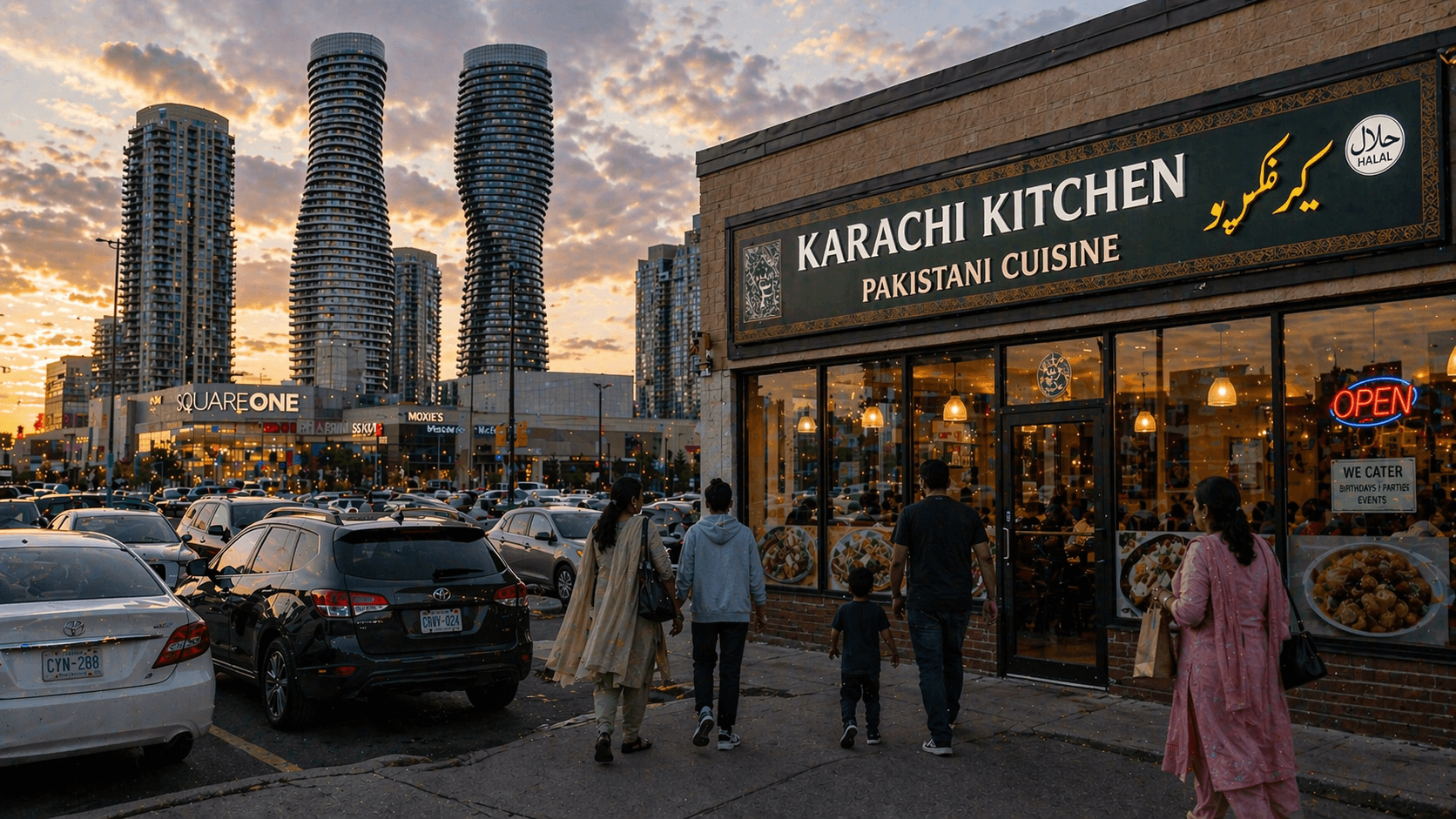
The Mississauga restaurant landscape right now
Mississauga's restaurants cluster into four very different worlds. Port Credit is the waterfront strip that behaves like a small-town patio scene on summer weekends. Streetsville is the charming main-street pocket with brunch loyalty. Hurontario and Derry, plus the Dixie corridor, form one of the strongest South Asian and halal restaurant markets in North America — home-ground for Paramount Fine Foods and dozens of independent Pakistani, Punjabi, and Afghan kitchens. The Square One belt around Hurontario and Burnhamthorpe is condo-driven and chain-heavy (Jack Astor's, Cactus Club, Earls), with indie spots competing on specialty. Unlike Toronto, most of Mississauga's restaurants live in plazas off major arterials, which means signage, Google Maps reviews, and parking-lot lighting matter more than street-front charm. Commuter flow to Toronto pulls disposable income out of the city Monday through Friday morning; the flip side is that Mississauga sees heavy evening and weekend traffic from residents who do not want to drive the QEW.
Mississauga's competitive picture is unique in Canada. Paramount Fine Foods is headquartered here and functions as a benchmark for quality halal at scale. Mandarin Restaurants built its reputation in the same corridor. On the indie side, the South Asian restaurant market is hyper-competitive and deeply social — WhatsApp recommendations inside Pakistani-Canadian and Punjabi-Canadian networks move covers faster than Google reviews do. Uber Eats penetration is very high, especially along the Hurontario corridor, because most restaurants are plaza-based and distances between guest and kitchen are manageable.
Local challenges
- Car-first street grid means foot traffic is almost zero — every cover is someone who decided to come to you
- Plaza signage and Google Maps presence matter more than street-front aesthetics
- Commuter bleed-off to Toronto takes the highest-spending diners off your Monday-through-Friday lunch
- Staff language diversity is a strength for diaspora marketing but a complication for training and consistency
- Uber Eats commission pressure is severe, especially for South Asian menus with thin per-item margins
Local opportunities
- Halal and South Asian restaurants can market inside WhatsApp family networks — organic reach dwarfs paid channels
- Condo density around Square One (30k+ units built since 2015) is underserved by indie delivery
- Port Credit patio summers deliver 40% of annual revenue for waterfront operators — optimize aggressively
- Ramadan iftar and Eid set-menus command premium pricing and pre-booking deposits
- Corporate lunch catering around the Airport Corporate Centre is untapped by most independents
How the seasons and cultural calendar shape sales
Mississauga's year is shaped as much by cultural calendars as by weather. Ramadan — roughly March or April depending on the lunar year — transforms the Hurontario corridor: iftar covers spike from sunset to midnight, and pre-dawn suhoor service pulls in a crowd that almost no other Canadian city has the volume to support. Eid al-Fitr and Eid al-Adha are two of the busiest restaurant days of the year. Diwali in late October or early November drives South Asian dining and banquet-hall reservations. Port Credit runs hot from Victoria Day through Labour Day, anchored by the Southside Shuffle Blues Festival and waterfront traffic. January and February are slow across the board. March Break drives a clear family-dining bump at mid-price chains near Square One.
8 ways to grow restaurant sales in Mississauga
These are the tactics that actually move covers, ordered from highest-impact to quietest-but-compounding. A few of the steps below are tuned specifically to Mississauga — the others are the standard independent-restaurant playbook that works city-wide.
- 1
Put a real digital menu on every table
A PDF behind a QR code is not a digital menu — guests bounce in three seconds. A proper digital menu loads in under two seconds on mobile, shows photos for hero items, and lets you mark a dish sold-out in one tap. Whatever platform you choose, test the menu on your own phone on cellular data in the dimmest corner of the venue; if it is slow there, it is slow everywhere.
- 2
Replace static QR with NFC tags on every table
QR codes work, but their friction — open camera, aim, tap notification — caps adoption well below what a tap achieves. NFC is one action with no app; every iPhone from 2016 and virtually every Android from the last decade reads it natively. Expect meaningful engagement lift on the same menu content, especially in full-service venues where guests already have a printed menu competing for attention.
- 3
Capture phone numbers from every table
The single most valuable asset a restaurant can build is a permission-based SMS list. Put NFC tags on the bill folder with a 'get our next special' opt-in. A 2,000-person list built over six months is worth more than any paid ad channel you can run — especially for seasonal reactivation, event weekends, and quiet Tuesdays.
- 4
Add tap-to-call-waiter and tap-to-request-bill
Guests dislike flagging down a server for basic requests — water, bill, extra napkins. An NFC tag on each table that routes to the assigned waiter's phone via push notification removes the awkward wave-and-wait. Table-turn speed tends to climb, and service perception improves — a quiet win that shows up in tips before it shows up in reviews.
- 5
Update your menu instantly when items sell out or prices change
86-ing a dish mid-service should take 3 seconds from your phone, not a staff-wide ticket and a pen-struck printed menu. A dashboard-driven digital menu lets you toggle availability, adjust prices, and roll in specials without reprinting anything — and without the guest awkwardly ordering something you ran out of at 7:30.
- 6
Run geo-targeted SMS blasts around events and weather
A Thursday-night 'patio is open and the sun is out' SMS to 800 local opt-ins outperforms a full week of Instagram ads for most independents. Same for game-night blasts within 2 km of Scotiabank Arena, or post-concert reactivation after Budweiser Stage shows. Your SMS list plus an event-calendar habit is the highest-ROI marketing channel most restaurants never actually build.
- 7
Build a WhatsApp broadcast list for your diaspora community
Mississauga's Pakistani, Punjabi, Afghan, and Filipino communities move faster on WhatsApp than on any public review site. An NFC lead-capture tag at the bill folder that routes opt-ins into a WhatsApp or SMS broadcast list (Tappflow's tags do this in one step) is the most direct way in. Send one iftar-time reminder, one weekend-special announcement, and one monthly loyalty offer — do not over-send, and your list becomes the most reliable revenue channel you have.
- 8
Run a Ramadan iftar pre-booking system
The 29-night iftar window produces predictable peak-night chaos. Put an NFC tag by the hostess stand that links to a reservation form for parties of 6+; require a $20-per-head deposit credited back on the bill. You will cut no-shows to under 5 percent and staff your floor confidently every single night.
Playing the Mississauga calendar
Every Mississauga restaurant year has a handful of days that deliver outsized revenue. Here is how to actually work them rather than let them wash over you.
- 1
Ramadan nightly iftar window — ~29 nights in March or April each year
Post the iftar time daily on the tabletop NFC menu so staff do not have to announce it. Pre-book family parties of 8+ via SMS seven days out — they will come anyway, but the booking prevents the 7:45 p.m. floor chaos.
- 2
Southside Shuffle Blues & Jazz Festival — Labour Day weekend, Port Credit
Patios south of Lakeshore get slammed — build a 'festival weekend' fixed menu, require reservations, and push a review-request SMS 24 hours after the visit while the memory is fresh.
- 3
Carassauga — Victoria Day weekend
The city's multicultural festival spreads across pavilions, but tied-in restaurants see a 20 to 30 percent lift when they pair cultural menu items with NFC-driven 'learn the story' pages.
- 4
Diwali & Eid — Varies, late Oct – Nov (Diwali) and after Ramadan (Eid)
Family reservations of 10+ dominate. Offer a branded takeout pickup menu via NFC for clients hosting at home — the average ticket is 3x a normal weeknight.
- 5
Mississauga Ribfest — Late June or July at Celebration Square
Surrounding restaurants can use Ribfest as a lead-capture play — the crowd is ambivalent to the BBQ vendors and happy to cross the street for anything that is not smoked.
Neighbourhood-by-neighbourhood
Tactics that work downtown often misfire in a plaza, and vice versa. The micro- markets below drive different dayparts, ticket sizes, and marketing channels.
Port Credit
Patio-driven waterfront brunch and dinner scene; summer-heavy, weather-sensitive.
Streetsville
Small-town main street with brunch loyalty and family-owned Italian.
Hurontario & Derry (Heartland)
South Asian and halal powerhouse — iftar rushes, banquet-hall dinners, 24-hour dessert cafes.
Square One / City Centre
Condo-density casual dining, chain-heavy, young-professional after-work.
Dixie & Bloor (Mississauga East)
Afghan, Ethiopian, Caribbean pockets off the airport corridor.
Local spotlight
Hurontario pattern: stagger reservations across the full iftar window — Hurontario & Derry
Halal venues along the Hurontario corridor see their sharpest spike in the 45 minutes after Maghrib during Ramadan. The ones that handle it best stop relying on walk-ins and lean into NFC-driven pre-booking (tap the table tag from home or the mosque to reserve), deliberately spreading reservations across the full iftar window rather than letting the 7:15–8:00 crush overwhelm the kitchen. A modest per-head deposit, credited back at the table, cuts no-shows sharply on the peak nights.
Running this playbook in Mississauga?
If you'd rather not stitch NFC hardware, menu software, and analytics from three different vendors, see how Tappflow's restaurant platform bundles them.
Frequently asked questions about restaurants in Mississauga
For any restaurant in or adjacent to the Hurontario and Derry corridor, Ramadan is genuinely the biggest operational event of the year — larger than December holidays. Kitchens run a compressed three-hour window (roughly iftar time through 10 p.m.) that can exceed the volume of an entire normal weekend. Staffing, pre-ordering supplies, and pre-booking reservations via NFC or SMS is the difference between a career-defining month and an exhausted, overwhelmed one.
It depends on whether you can hibernate costs in the off-season. Restaurants that lean into summer patios with a simpler winter model (tight menu, reduced hours) can make Port Credit work. Restaurants that try to run a 120-seat full menu year-round struggle from November through March. Capture phone numbers aggressively during summer visits — that list is what carries you through the winter with targeted reactivation campaigns.
Airport-adjacent hotels (Hilton, Sheraton, Delta near Dixon Road) drive a quieter but steady stream of business travellers looking for dinner within a 10-minute drive. A well-placed NFC 'tap for menu and reservation' QR-plus-tag card at hotel concierge desks can lift Tuesday-through-Thursday covers meaningfully with near-zero ad spend.
A typical 40-seat restaurant takes about an afternoon. You receive pre-programmed tags, stick one to each table (or under the lip), confirm each is bound to the correct table in your dashboard, and you are live. There is no app for guests to install — they tap their phone and the menu opens instantly.
On every iPhone from the iPhone 7 (2016) forward, and on virtually every Android phone from the last decade. iPhone XS and newer read tags in the background with no app open — just tap and the menu opens. For the rare edge case, most tag cards also carry a printed QR as a fallback so nobody is excluded.
Software sits in the $0–$50/month range for most single-location venues in 2026; Tappflow specifically has a free tier that covers the core digital menu, with paid tiers when you need more menus, languages, or SMS volume. Hardware is a one-time purchase — NFC tags are durable for years of daily tapping, so spread across the tables and a few years of life, the per-tap cost is negligible.
Keep reading
How to Create a Digital Menu for Your Restaurant (Step-by-Step Guide 2026)
Everything you need to launch a working digital menu — from choosing between QR and NFC access to AI menu import, 44+ language translations, and going live for free in an afternoon.
NFC vs QR Codes for Restaurants: Which Actually Works Better?
Cost, friction, analytics, and durability — a no-hype breakdown of where NFC beats QR and where QR still has a place at the table.