The playbook below applies to any tools you run — POS, menu software, marketing stack, whatever. Where a specific tool makes a tactic easier to execute, we name it; Tappflow's restaurant platform happens to cover several of the steps in one place.
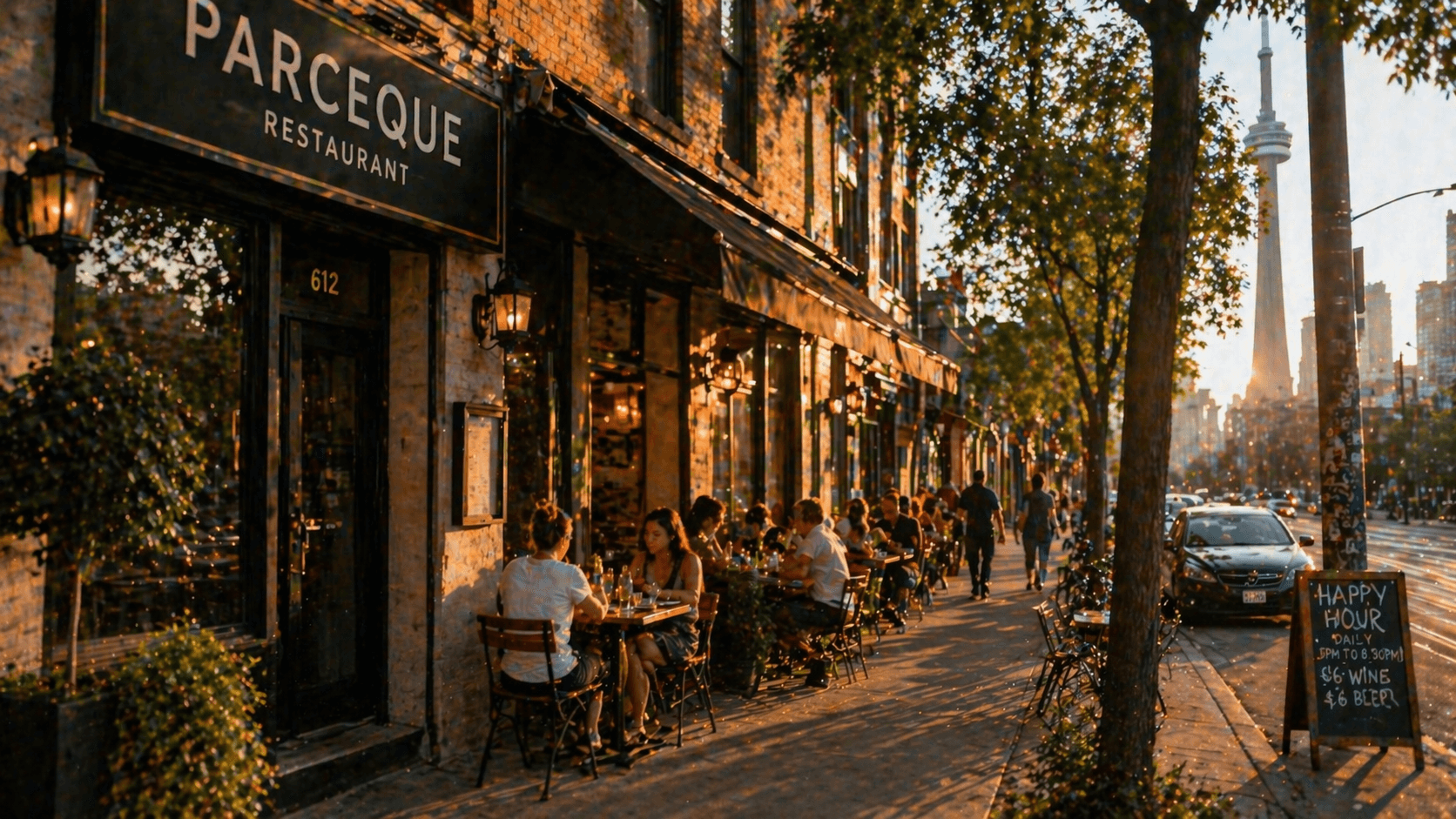
The Toronto restaurant landscape right now
Toronto's restaurant scene runs across at least six distinct sub-markets that barely overlap. The Financial District lives on weekday lunch traffic flowing up through the PATH. King West and Ossington chase dinner-and-drinks with a 6 p.m. rush that evaporates by 11. Queen West leans on creative-class brunch and post-gallery dinners. Leslieville and Roncesvalles run on neighbourhood loyalty and stroller-friendly patios. Scarborough and North York carry some of the country's deepest diaspora food scenes — Agincourt's Chinese corridors, Scarborough's Tamil and Ethiopian pockets, North York's Korean and Persian belts along Yonge. Commercial rents on prime King, Queen and Yonge stretches are among the highest in Canada, which pushes operators to either lean into high-ticket tasting menus or squeeze extra turns out of the same footprint. The diner pool is enormous (6.4M in the GTA) but attention is fragmented across delivery apps, Instagram discovery, and newsletter tipsters like blogTO — so a restaurant that is merely good rarely gets found.
Toronto operators compete against three fronts at once: Oliver & Bonacini and Terroni-style mini-chains with real brand muscle, a restless indie scene where a new concept opens every week on Dundas West, and the delivery apps themselves — Uber Eats, DoorDash, and SkipTheDishes now intercept a 20 to 35 percent cut of dinner demand in most central neighbourhoods. Staff turnover sits around 70 percent annually and rising, which makes service consistency the hidden lever. The winning indies tend to share one trait: a clear, narrow identity that shows up in every guest touchpoint, from the sign out front to the thank-you text after the meal.
Local challenges
- Commercial rent on King and Queen routinely exceeds $100 per square foot, leaving little margin for slow shifts
- 13% HST and Ontario tip-pooling rules mean published prices need careful framing to avoid sticker shock
- Uber Eats and DoorDash commissions of 20 to 35 percent erode profitability on delivery-heavy nights
- Streetcar and construction disruptions on Queen and King close revenue taps with 48 hours' notice
- Staff turnover above 70 percent annually makes service consistency the first thing to drop on busy weeks
Local opportunities
- PATH lunch traffic is still underserved by indie operators willing to run a tight 12 to 2 p.m. window
- Diaspora-specific marketing via WhatsApp and WeChat punches above its weight for Chinese, Persian, and South Asian venues
- Condo pre-order delivery (same 1 km, not app-mediated) captures 18 percent margins versus 8 percent on Uber Eats
- Post-concert and post-game SMS blasts to within 2 km of venues convert at 4 to 7 percent when the timing is right
- Patio SMS 'the sun is out and we have two tables' blasts on last-minute Thursdays outperform any paid digital channel
How the seasons and cultural calendar shape sales
Toronto sales move in a predictable wave. January and February are brutal — dry-January, cold snaps on College Street, and post-holiday credit-card hangovers combine to drop covers 25 to 40 percent versus December. March Break brings a family-dining bump. Patio season (roughly May 1 through Thanksgiving weekend) is where the year is won or lost: a restaurant with twelve sidewalk seats on Ossington can double summer revenue, but the same patio is unusable by late October. September brings a massive TIFF spike for venues within walking distance of the festival's King Street hub. November is soft, then December runs hot for office parties and pre-holiday dinners. Raptors and Leafs playoff runs reliably light up every bar within two kilometres of Scotiabank Arena.
8 ways to grow restaurant sales in Toronto
These are the tactics that actually move covers, ordered from highest-impact to quietest-but-compounding. A few of the steps below are tuned specifically to Toronto — the others are the standard independent-restaurant playbook that works city-wide.
- 1
Put a real digital menu on every table
A PDF behind a QR code is not a digital menu — guests bounce in three seconds. A proper digital menu loads in under two seconds on mobile, shows photos for hero items, and lets you mark a dish sold-out in one tap. Whatever platform you choose, test the menu on your own phone on cellular data in the dimmest corner of the venue; if it is slow there, it is slow everywhere.
- 2
Replace static QR with NFC tags on every table
QR codes work, but their friction — open camera, aim, tap notification — caps adoption well below what a tap achieves. NFC is one action with no app; every iPhone from 2016 and virtually every Android from the last decade reads it natively. Expect meaningful engagement lift on the same menu content, especially in full-service venues where guests already have a printed menu competing for attention.
- 3
Capture phone numbers from every table
The single most valuable asset a restaurant can build is a permission-based SMS list. Put NFC tags on the bill folder with a 'get our next special' opt-in. A 2,000-person list built over six months is worth more than any paid ad channel you can run — especially for seasonal reactivation, event weekends, and quiet Tuesdays.
- 4
Add tap-to-call-waiter and tap-to-request-bill
Guests dislike flagging down a server for basic requests — water, bill, extra napkins. An NFC tag on each table that routes to the assigned waiter's phone via push notification removes the awkward wave-and-wait. Table-turn speed tends to climb, and service perception improves — a quiet win that shows up in tips before it shows up in reviews.
- 5
Update your menu instantly when items sell out or prices change
86-ing a dish mid-service should take 3 seconds from your phone, not a staff-wide ticket and a pen-struck printed menu. A dashboard-driven digital menu lets you toggle availability, adjust prices, and roll in specials without reprinting anything — and without the guest awkwardly ordering something you ran out of at 7:30.
- 6
Run geo-targeted SMS blasts around events and weather
A Thursday-night 'patio is open and the sun is out' SMS to 800 local opt-ins outperforms a full week of Instagram ads for most independents. Same for game-night blasts within 2 km of Scotiabank Arena, or post-concert reactivation after Budweiser Stage shows. Your SMS list plus an event-calendar habit is the highest-ROI marketing channel most restaurants never actually build.
- 7
Own the PATH lunch slot with a 12-minute kitchen promise
Financial District office workers have roughly 45 minutes to leave the desk, eat, and get back. Advertise a lunch menu that guarantees food on the table within 12 minutes of ordering — then use tap-to-order NFC tags at every table so a suit with a laptop can skip the waitress flag and get the sandwich coming. This is a measurable conversion tactic you can price-test against regular lunch covers.
- 8
Build a TIFF-week playbook and run it every September
Most restaurants treat TIFF as a nuisance (service disruptions on King). The ones that make September a $60k-above-baseline month build a specific press-dinner menu, staff up one extra server for festival-week Tuesdays, and put NFC tags in the windows that go straight to a reservation page so a producer walking by books without calling.
Playing the Toronto calendar
Every Toronto restaurant year has a handful of days that deliver outsized revenue. Here is how to actually work them rather than let them wash over you.
- 1
Toronto International Film Festival (TIFF) — Early-mid September
Raise covers window around King & John by 30 to 60 percent. Offer a fixed 'press dinner' menu that ships in 45 minutes — the festival schedule is tight. Display the menu on NFC tags at the bar for walk-ins who do not have reservations.
- 2
Caribana (Toronto Caribbean Carnival) — Late July through early August
Patios within 1 km of the Lakeshore route run at capacity for four days. Pre-book parties of 6+ two weeks out and push Caribbean-themed menu items surfaced via NFC on the same tag as the regular menu.
- 3
Raptors / Leafs playoff runs — April through June, depending on run
Any bar or restaurant with a TV within 2 km of Scotiabank Arena should blast SMS on game days. Pre-orders submitted during the first period via tap-to-order go from kitchen to table 40 percent faster.
- 4
Taste of the Danforth — Early August
Greek corridor restaurants see three days of tourist traffic. Capture phone numbers for reactivation in September when the crowd dies down but the memory is fresh.
- 5
Winterlicious / Summerlicious — Late January and early July
City-run prix-fixe program drives new-diner trial. Upsell drinks and dessert via tabletop NFC menus — the fixed price is bait, add-ons are where the margin lives.
Neighbourhood-by-neighbourhood
Tactics that work downtown often misfire in a plaza, and vice versa. The micro- markets below drive different dayparts, ticket sizes, and marketing channels.
King West & Wellington
After-work drinks, tech-office dinner groups, late-night bottle service.
Queen West & Ossington
Brunch crowds, creative-industry dinners, gallery-adjacent walk-ins.
Leslieville & Riverside
Neighbourhood brunch loyalists, stroller patios, date nights without the downtown tax.
Yonge & Eglinton
Condo density, midweek casual dining, post-gym health bowls.
Scarborough (Agincourt / Kennedy)
Destination diaspora dining — Cantonese, Tamil, Filipino, Ethiopian.
North York (Yonge north of Sheppard)
Korean BBQ row, Persian kebab halls, late-night dessert cafes.
Local spotlight
Kensington Market pattern: the walk-up-and-tap morning rush — Kensington Market
The market's morning rhythm rewards speed — coffee, sandwich, grab-and-go. Walk-up counters that put NFC tags at the outdoor order point, with a clearly-marked pickup window a few steps away, compress the whole interaction into a handful of minutes. The make-or-break detail is signage, not software: guests need to see the tap target from the sidewalk, not discover it at the counter after they've already queued.
The numbers behind the Toronto market
- Licensed restaurants in the GTA: ~14,600 (Restaurants Canada, 2025 estimate)
- Foodservice share of consumer spend: ~38% of Ontario food dollars
- Average delivery commission drag: 20–35% of delivery ticket
Running this playbook in Toronto?
If you'd rather not stitch NFC hardware, menu software, and analytics from three different vendors, see how Tappflow's restaurant platform bundles them.
Frequently asked questions about restaurants in Toronto
For most indie operators on Queen, College, Ossington, King West, or Dundas West, yes. A twelve-seat sidewalk patio can represent 25 to 40 percent of May-through-October revenue and is often the difference between a profitable year and break-even. Municipal CaféTO permits open each spring — apply early and budget for the outdoor-rated NFC tags so guests can order without waiting for the single server who keeps running between inside and outside.
It depends on your price point and kitchen capacity. Restaurants with tickets under $25 and idle kitchen capacity between services benefit. Sit-down venues with tickets above $35, limited kitchen bandwidth, or a strong dine-in identity usually lose money on Uber Eats commissions once you factor in packaging, staff labour, and the risk of delivery drivers tanking your rating. A direct-order NFC-powered menu plus a pick-up window beats Uber Eats for repeat customers within a 1 km radius.
Build an SMS list from day one so you can notify guests when your side of the street reopens. An NFC lead-capture tag at the bill folder with a small 'get $5 off your next visit' opt-in quietly builds a reusable marketing channel — platforms like Tappflow include this capture flow by default. A couple of thousand opt-ins over a year becomes a real insurance policy against the next streetcar replacement project.
A typical 40-seat restaurant takes about an afternoon. You receive pre-programmed tags, stick one to each table (or under the lip), confirm each is bound to the correct table in your dashboard, and you are live. There is no app for guests to install — they tap their phone and the menu opens instantly.
On every iPhone from the iPhone 7 (2016) forward, and on virtually every Android phone from the last decade. iPhone XS and newer read tags in the background with no app open — just tap and the menu opens. For the rare edge case, most tag cards also carry a printed QR as a fallback so nobody is excluded.
Software sits in the $0–$50/month range for most single-location venues in 2026; Tappflow specifically has a free tier that covers the core digital menu, with paid tiers when you need more menus, languages, or SMS volume. Hardware is a one-time purchase — NFC tags are durable for years of daily tapping, so spread across the tables and a few years of life, the per-tap cost is negligible.
Keep reading
How to Create a Digital Menu for Your Restaurant (Step-by-Step Guide 2026)
Everything you need to launch a working digital menu — from choosing between QR and NFC access to AI menu import, 44+ language translations, and going live for free in an afternoon.
NFC vs QR Codes for Restaurants: Which Actually Works Better?
Cost, friction, analytics, and durability — a no-hype breakdown of where NFC beats QR and where QR still has a place at the table.