The playbook below applies to any tools you run — POS, menu software, marketing stack, whatever. Where a specific tool makes a tactic easier to execute, we name it; Tappflow's restaurant platform happens to cover several of the steps in one place.
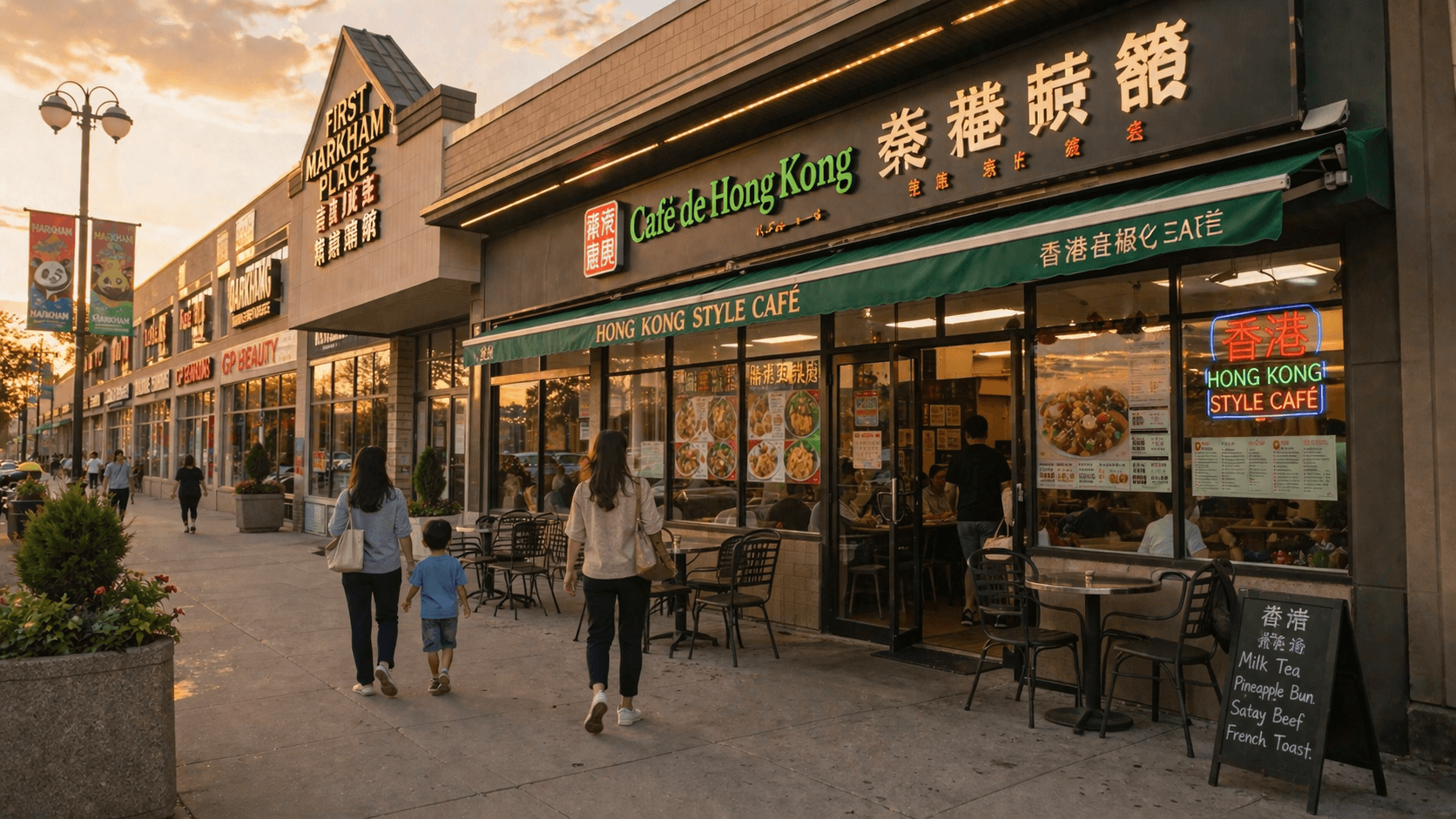
The Markham restaurant landscape right now
Markham's restaurant scene centres on a tight belt of Cantonese, Mandarin-Chinese, Taiwanese, Hong Kong-style cafe (cha chaan teng), Sichuan, Korean, and Japanese kitchens concentrated around First Markham Place, Pacific Mall, Remington Centre, and the Highway 7 corridor from Leslie to Kennedy. Unionville — the historic village along Main Street — is the outlier: Victorian storefronts, patio brunch, and a more European-Canadian dining profile. Downtown Markham (the newer condo-dense development north of Highway 7) is building out a different scene of modern Japanese, Korean, and upscale Chinese restaurants aimed at the condo-dwelling professional class. Markham restaurants typically run a weekly or daily rotating menu — far more dynamic than a Toronto restaurant's seasonal menu change — and Instagram-equivalent platforms like Xiaohongshu (Little Red Book) drive new-diner trial faster than any English-language review site.
Markham's restaurant market is hyper-competitive within narrow lanes. Cantonese barbecue (char siu, roast duck, siu yuk) has a dozen destination kitchens within five kilometres — a single dish being off on a given day loses loyal customers to the next plaza. Hong Kong-style cafes run head-to-head with each other on breakfast pricing and tea quality. Sichuan and Northern Chinese kitchens compete on authenticity signals (the number of Mainland Mandarin speakers on staff). Xiaohongshu and WeChat reviews move covers faster than Google does, and a viral post can triple dinner bookings within 48 hours. Japanese omakase is growing rapidly in the downtown Markham area.
Local challenges
- Xiaohongshu and WeChat reviews are opaque to non-Chinese-speaking owners but drive covers faster than Google
- Weekly menu rotations require kitchen discipline most operators underestimate
- Cantonese BBQ competition is so tight that a single off-day on roast duck can lose a regular to the next plaza
- Downtown Markham condo professionals expect reservations and table management at a level most plaza restaurants do not offer
- Bilingual staff recruitment (English + Cantonese or Mandarin) is harder and pricier every year
Local opportunities
- NFC ordering in Chinese and English removes the bilingual menu friction that slows tables
- Diaspora-specific promotion via WeChat groups outperforms any English-language paid channel
- Lunar New Year fixed-price banquets can be sold out 45 days in advance with the right NFC pre-booking flow
- Omakase and upscale concepts are rapidly expanding in Downtown Markham's condo corridor
- Corporate catering around Markham tech and life-sciences parks is still undercounted by most indies
How the seasons and cultural calendar shape sales
Lunar New Year is the biggest restaurant week of the year. Many kitchens serve prix-fixe reunion banquets — eight courses, required pre-booking, deposits 30 days out — and see revenue equivalent to an entire normal month in those 10 days. The Mid-Autumn Festival in September and early October drives banquet bookings and mooncake pre-sales. Ramadan is less of a factor than in Mississauga but meaningful along Steeles for the Muslim community. Summer patio season is weaker in Markham than in Toronto or Burlington because most restaurants are plaza-based and the flagship venues are built for interior climate-controlled dining. Student traffic from York University's downtown Markham campus grows each year. Winter is peak indoor-dining season, with Chinese-Canadian families returning to regular kitchens weekly.
8 ways to grow restaurant sales in Markham
These are the tactics that actually move covers, ordered from highest-impact to quietest-but-compounding. A few of the steps below are tuned specifically to Markham — the others are the standard independent-restaurant playbook that works city-wide.
- 1
Put a real digital menu on every table
A PDF behind a QR code is not a digital menu — guests bounce in three seconds. A proper digital menu loads in under two seconds on mobile, shows photos for hero items, and lets you mark a dish sold-out in one tap. Whatever platform you choose, test the menu on your own phone on cellular data in the dimmest corner of the venue; if it is slow there, it is slow everywhere.
- 2
Replace static QR with NFC tags on every table
QR codes work, but their friction — open camera, aim, tap notification — caps adoption well below what a tap achieves. NFC is one action with no app; every iPhone from 2016 and virtually every Android from the last decade reads it natively. Expect meaningful engagement lift on the same menu content, especially in full-service venues where guests already have a printed menu competing for attention.
- 3
Capture phone numbers from every table
The single most valuable asset a restaurant can build is a permission-based SMS list. Put NFC tags on the bill folder with a 'get our next special' opt-in. A 2,000-person list built over six months is worth more than any paid ad channel you can run — especially for seasonal reactivation, event weekends, and quiet Tuesdays.
- 4
Add tap-to-call-waiter and tap-to-request-bill
Guests dislike flagging down a server for basic requests — water, bill, extra napkins. An NFC tag on each table that routes to the assigned waiter's phone via push notification removes the awkward wave-and-wait. Table-turn speed tends to climb, and service perception improves — a quiet win that shows up in tips before it shows up in reviews.
- 5
Update your menu instantly when items sell out or prices change
86-ing a dish mid-service should take 3 seconds from your phone, not a staff-wide ticket and a pen-struck printed menu. A dashboard-driven digital menu lets you toggle availability, adjust prices, and roll in specials without reprinting anything — and without the guest awkwardly ordering something you ran out of at 7:30.
- 6
Run geo-targeted SMS blasts around events and weather
A Thursday-night 'patio is open and the sun is out' SMS to 800 local opt-ins outperforms a full week of Instagram ads for most independents. Same for game-night blasts within 2 km of Scotiabank Arena, or post-concert reactivation after Budweiser Stage shows. Your SMS list plus an event-calendar habit is the highest-ROI marketing channel most restaurants never actually build.
- 7
Offer a bilingual tap-to-order NFC menu
Markham tables often include English-speaking grandchildren ordering alongside Cantonese-first grandparents. A tap-to-order NFC menu with a single-tap language toggle (Chinese / English) removes the hostess-translating-for-the-kitchen bottleneck that slows every other table on a Saturday night. Kitchens that run this see order accuracy improve meaningfully and tables turn 10 to 15 percent faster.
- 8
Build a WeChat channel and cross-post Xiaohongshu
Your competitors' covers are being decided inside WeChat groups you cannot see. An NFC lead-capture tag at the bill folder that routes to a WeChat-or-WhatsApp opt-in captures diners who would never have added you on Instagram (Tappflow's tags handle this, with Simplified Chinese rendering on the menu side). Combined with one Xiaohongshu post a week from a reliable local creator, it's the fastest way to cross into the dominant discovery channel.
Playing the Markham calendar
Every Markham restaurant year has a handful of days that deliver outsized revenue. Here is how to actually work them rather than let them wash over you.
- 1
Lunar New Year / Chinese New Year — Late January or February (15 days)
Pre-book reunion banquets with non-refundable deposits starting 45 days out. NFC-powered menu pages should switch to a LNY fixed-menu for two weeks — no substitutions, no custom orders. The kitchen cannot support it and guests are not asking for it.
- 2
Mid-Autumn (Mooncake) Festival — Mid-September to early October
Mooncake pre-sales and family banquet bookings drive two weeks of elevated revenue. NFC order pages for mooncake boxes are more efficient than phone orders.
- 3
Markham Ribfest — Late June, Markham Fairgrounds
Less direct impact than in Burlington, but a useful lead-capture moment for surrounding restaurants offering 'not-ribs' alternatives.
- 4
Unionville Festival — First weekend of June
Unionville Main Street restaurants see 25,000+ visitors over two days. Every patio is full; pre-booking is essential.
- 5
Night Market at Downtown Markham — Select summer weekends
Draws 30k-plus per night. Surrounding restaurants can use NFC lead-capture stations to build condo-resident lists.
Neighbourhood-by-neighbourhood
Tactics that work downtown often misfire in a plaza, and vice versa. The micro- markets below drive different dayparts, ticket sizes, and marketing channels.
Unionville (Main Street)
Historic Victorian village — patio brunch, wine bars, destination walk-up traffic.
First Markham Place / Pacific Mall corridor
Dense Cantonese, Hong Kong cafe, Taiwanese, and regional Chinese kitchens — the heart of GTA Chinese dining.
Downtown Markham (new condo core)
Modern Japanese, Korean BBQ, upscale Chinese — condo professionals, later dining hours.
Cornell & Markham Village
Family-casual, breakfast diners, long-standing Canadian-Italian and pub spots.
Milliken / Steeles corridor
Dim sum, Korean, and Vietnamese — car-first, plaza-heavy, high regular turnover.
Local spotlight
First Markham Place pattern: speed as a differentiator at weekend dim sum — First Markham Place
The HK-style cafes and dim sum venues around First Markham Place compete on speed for the Saturday-morning party-of-six crowd. NFC table ordering shifts the bottleneck from server-fetching to kitchen-capacity — which is the part you can actually staff up. Tips climb as a side effect: servers redirect their time from menu-flipping to drink refills and upsells. The same move rarely helps dinner service at slower-paced venues, where the pace is the product.
Running this playbook in Markham?
If you'd rather not stitch NFC hardware, menu software, and analytics from three different vendors, see how Tappflow's restaurant platform bundles them.
Frequently asked questions about restaurants in Markham
For any Chinese restaurant in Markham, Lunar New Year is the largest revenue window of the year — a 10-day stretch that can equal the revenue of a normal full month. Kitchens either build a fixed prix-fixe reunion menu with pre-booked deposits, or they lose the week to chaos. Starting NFC-based pre-booking 45 days out lets you pace the kitchen, require deposits that protect against no-shows, and stop taking walk-ins you cannot serve.
For most venues east of Leslie, yes. Tables commonly include three generations with mixed language preferences. The modern answer is not to print two physical menus — it is to run an NFC-powered digital menu with a single-tap language toggle, which also lets you update prices instantly across both languages without reprinting anything.
A typical 40-seat restaurant takes about an afternoon. You receive pre-programmed tags, stick one to each table (or under the lip), confirm each is bound to the correct table in your dashboard, and you are live. There is no app for guests to install — they tap their phone and the menu opens instantly.
On every iPhone from the iPhone 7 (2016) forward, and on virtually every Android phone from the last decade. iPhone XS and newer read tags in the background with no app open — just tap and the menu opens. For the rare edge case, most tag cards also carry a printed QR as a fallback so nobody is excluded.
Software sits in the $0–$50/month range for most single-location venues in 2026; Tappflow specifically has a free tier that covers the core digital menu, with paid tiers when you need more menus, languages, or SMS volume. Hardware is a one-time purchase — NFC tags are durable for years of daily tapping, so spread across the tables and a few years of life, the per-tap cost is negligible.
Keep reading
How to Create a Digital Menu for Your Restaurant (Step-by-Step Guide 2026)
Everything you need to launch a working digital menu — from choosing between QR and NFC access to AI menu import, 44+ language translations, and going live for free in an afternoon.
NFC vs QR Codes for Restaurants: Which Actually Works Better?
Cost, friction, analytics, and durability — a no-hype breakdown of where NFC beats QR and where QR still has a place at the table.