The playbook below applies to any tools you run — POS, menu software, marketing stack, whatever. Where a specific tool makes a tactic easier to execute, we name it; Tappflow's restaurant platform happens to cover several of the steps in one place.
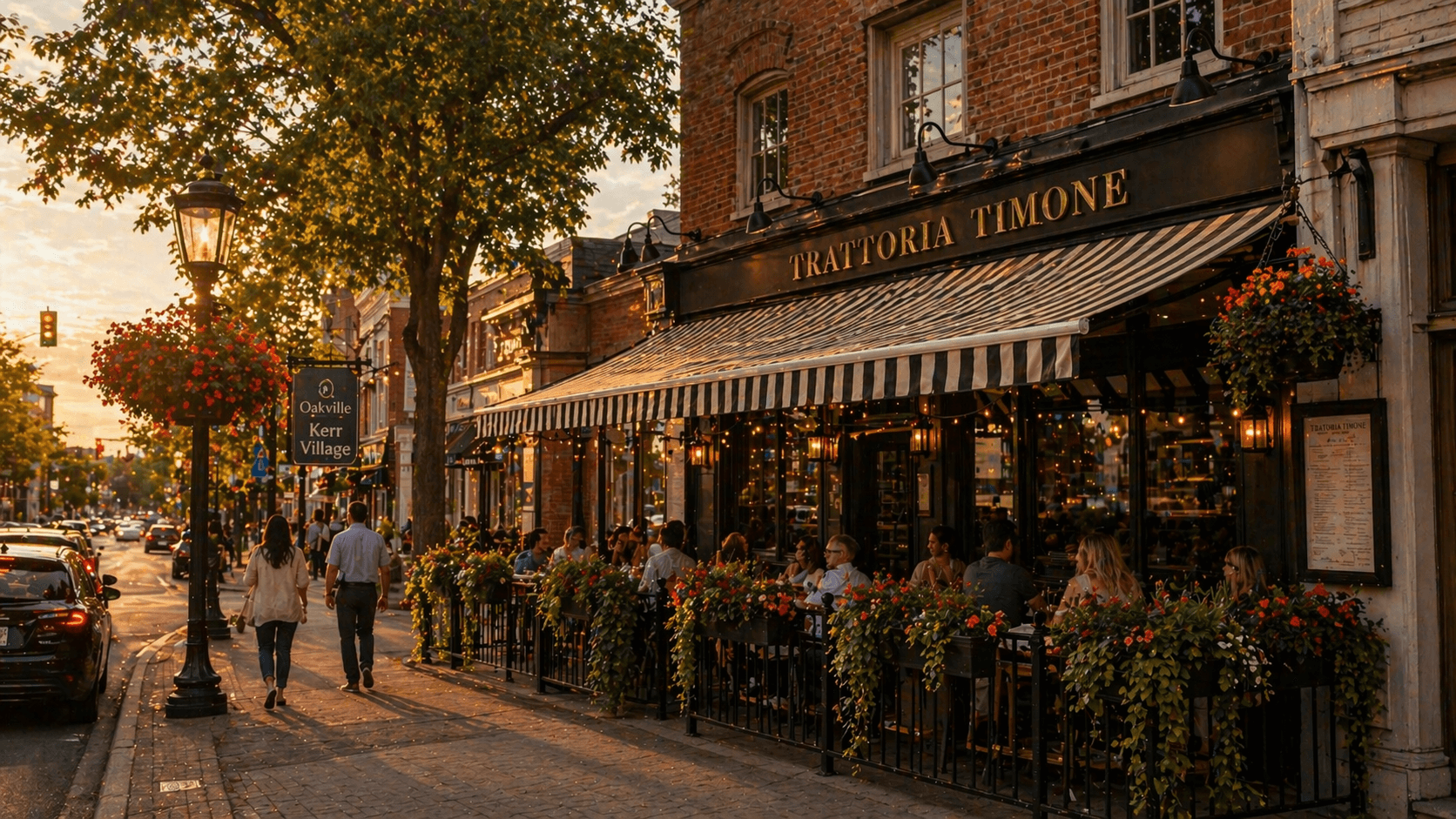
The Oakville restaurant landscape right now
Oakville's restaurant scene concentrates on three walkable strips — Lakeshore Road in downtown Oakville, Kerr Village to the west, and Bronte Village around the marina — plus a scattering of upscale-casual venues in Glen Abbey and along Dundas. Downtown Oakville's Lakeshore Road is the flagship: boutique Italian, modern bistro, wine bars, steakhouses, and a strong brunch scene anchored by a well-heeled resident base. Bronte Village runs on summer waterfront traffic and family dining. Kerr Village has become the city's most creative strip, with newer concepts (Mexican, Vietnamese, craft breweries) arriving in the last five years. The chain presence (Joey's, Seasons 52, Cactus Club) is concentrated around the Oakville Place trade area and along the QEW. Oakville's average household disposable income is among the highest in Ontario — diners expect polish, reservations, and wine lists, and they reward service consistency with long-term loyalty.
Oakville's restaurant competition is polished and closely watched. A handful of Lakeshore Road institutions (upscale Italian, French bistro, modern steakhouse) define the quality bar, and new entrants are judged quickly against them. Chain venues around Oakville Place compete mainly for weekday corporate lunches and weeknight casual date nights. Bronte Village's competitive set is tighter — a small number of marina-side restaurants split summer tourist traffic. Kerr Village is where new concepts have the most room to breathe, but the trade area is smaller. Google reviews and Oakville News coverage move covers meaningfully here in a way they do not in Markham or Brampton.
Local challenges
- Premium Lakeshore Road rent demands consistent dinner ticket averages most newcomers underestimate
- Conservative aging clientele rewards polish and consistency but is slow to try new concepts
- Weather-dependent patios leave 120 seats unusable for 6 months of the year
- Dry January hits upscale bar-driven venues disproportionately hard
- Staff expectations (tenure, wage) are higher than inland 905 — budget for it
Local opportunities
- Anniversary, Valentine's, and milestone birthday dining are over-represented versus the GTA average
- Pre-theatre dining at Oakville Centre for the Performing Arts is a repeatable weekly revenue stream
- Private event and corporate client-dinner catering is underserved by indies — local firms spend significantly
- Kerr Village is the most fertile ground for new concepts with real room to grow
- Bronte marina summer brunch can set up the entire year if phone numbers are captured aggressively
How the seasons and cultural calendar shape sales
Patio season (mid-May through mid-October) is critical — Lakeshore Road and Bronte waterfront patios fill on every warm weekend, and a restaurant without outdoor seating runs 20 to 30 percent behind through summer. Dickens Days in December transforms downtown Oakville into a destination for holiday-themed dining and pre-theatre dinners tied to the Oakville Centre for the Performing Arts. Valentine's Day and anniversary dining are disproportionately strong. The Tim Horton's Canadian Open (tennis) pulls some spillover traffic to Jane-connected corridors when held at Aviva Centre, though Toronto captures most of it. Bronte's marina drives strong summer brunch and family lunch traffic. January and February are the slowest stretch, especially during dry January — bar-driven venues suffer disproportionately.
8 ways to grow restaurant sales in Oakville
These are the tactics that actually move covers, ordered from highest-impact to quietest-but-compounding. A few of the steps below are tuned specifically to Oakville — the others are the standard independent-restaurant playbook that works city-wide.
- 1
Put a real digital menu on every table
A PDF behind a QR code is not a digital menu — guests bounce in three seconds. A proper digital menu loads in under two seconds on mobile, shows photos for hero items, and lets you mark a dish sold-out in one tap. Whatever platform you choose, test the menu on your own phone on cellular data in the dimmest corner of the venue; if it is slow there, it is slow everywhere.
- 2
Replace static QR with NFC tags on every table
QR codes work, but their friction — open camera, aim, tap notification — caps adoption well below what a tap achieves. NFC is one action with no app; every iPhone from 2016 and virtually every Android from the last decade reads it natively. Expect meaningful engagement lift on the same menu content, especially in full-service venues where guests already have a printed menu competing for attention.
- 3
Capture phone numbers from every table
The single most valuable asset a restaurant can build is a permission-based SMS list. Put NFC tags on the bill folder with a 'get our next special' opt-in. A 2,000-person list built over six months is worth more than any paid ad channel you can run — especially for seasonal reactivation, event weekends, and quiet Tuesdays.
- 4
Add tap-to-call-waiter and tap-to-request-bill
Guests dislike flagging down a server for basic requests — water, bill, extra napkins. An NFC tag on each table that routes to the assigned waiter's phone via push notification removes the awkward wave-and-wait. Table-turn speed tends to climb, and service perception improves — a quiet win that shows up in tips before it shows up in reviews.
- 5
Update your menu instantly when items sell out or prices change
86-ing a dish mid-service should take 3 seconds from your phone, not a staff-wide ticket and a pen-struck printed menu. A dashboard-driven digital menu lets you toggle availability, adjust prices, and roll in specials without reprinting anything — and without the guest awkwardly ordering something you ran out of at 7:30.
- 6
Run geo-targeted SMS blasts around events and weather
A Thursday-night 'patio is open and the sun is out' SMS to 800 local opt-ins outperforms a full week of Instagram ads for most independents. Same for game-night blasts within 2 km of Scotiabank Arena, or post-concert reactivation after Budweiser Stage shows. Your SMS list plus an event-calendar habit is the highest-ROI marketing channel most restaurants never actually build.
- 7
Run a pre-theatre NFC reservation flow tied to Oakville Centre shows
The Oakville Centre for the Performing Arts publishes its season calendar annually. Partner on an NFC 'pre-show dining' reservation flow with a 5:30 p.m. start time and a 7:15 dessert cutoff — this reliably fills midweek seats that would otherwise be empty and positions your venue as the default pre-theatre choice.
- 8
Build an anniversary reactivation SMS calendar
Oakville diners are disproportionately likely to return on the same date annually (wedding anniversaries, birthdays). Use NFC lead-capture at the bill folder to collect phone numbers plus the occasion, then send a one-touch 'your anniversary is next month — here is our reservation link' SMS 30 days out. Return rate is typically 25 to 40 percent — higher than any paid channel.
Playing the Oakville calendar
Every Oakville restaurant year has a handful of days that deliver outsized revenue. Here is how to actually work them rather than let them wash over you.
- 1
Dickens Days — Late November through December
Downtown Oakville transforms. Pre-theatre and holiday reservations dominate — lock in parties of 6+ via NFC reservation flows 30 days out.
- 2
Jazz Festival — Late summer
Lakeshore Road patios fill. Capture phone numbers at NFC bill-folder taps for reactivation outside the festival window.
- 3
Midnight Madness — Mid-July
Downtown walking-crowd event — restaurants with sidewalk visibility see high walk-in conversion.
- 4
Waterfront Festival — Mid-June
Coronation Park fills; Bronte and Lakeshore West restaurants see a strong weekend bump.
- 5
Valentine's / anniversary season — Mid-February and May
Oakville's anniversary-dining market is disproportionately large. Pre-booked fixed-menu upsells via NFC command a premium.
Neighbourhood-by-neighbourhood
Tactics that work downtown often misfire in a plaza, and vice versa. The micro- markets below drive different dayparts, ticket sizes, and marketing channels.
Downtown Oakville (Lakeshore Road)
Boutique upscale — Italian, bistro, wine bars, pre-theatre dining, holiday Dickens Days.
Bronte Village
Marina-adjacent brunch and seafood, family-friendly, summer-heavy.
Kerr Village
Creative strip — Mexican, Vietnamese, craft brewery, newer concepts.
Glen Abbey & Dundas corridor
Suburban upscale casual, chain mix, corporate lunch anchors.
Oakville Place area
Mall-driven chain dominance — Cactus Club, Joey's, Earls.
Running this playbook in Oakville?
If you'd rather not stitch NFC hardware, menu software, and analytics from three different vendors, see how Tappflow's restaurant platform bundles them.
Frequently asked questions about restaurants in Oakville
Yes — Oakville diners spend more per cover, reward polish more strongly, and return for occasion dining more reliably. The flip side is that launch costs are higher and new concepts take longer to build loyalty. Tactics that work in Mississauga (volume delivery, WhatsApp broadcast, iftar scheduling) are mostly irrelevant here. Tactics around reservation management, anniversary reactivation, and pre-theatre timing are disproportionately powerful.
For Lakeshore Road and Bronte Village venues, yes — a 30- to 60-seat patio can represent 30 percent of annual revenue, and a restaurant without outdoor seating visibly lags its neighbours through summer. Apply for municipal patio permits early each spring, and plan for outdoor-rated NFC tags so guests can order without waiting for staff to travel in and out. Budget for heaters to stretch patio season into late October.
A typical 40-seat restaurant takes about an afternoon. You receive pre-programmed tags, stick one to each table (or under the lip), confirm each is bound to the correct table in your dashboard, and you are live. There is no app for guests to install — they tap their phone and the menu opens instantly.
On every iPhone from the iPhone 7 (2016) forward, and on virtually every Android phone from the last decade. iPhone XS and newer read tags in the background with no app open — just tap and the menu opens. For the rare edge case, most tag cards also carry a printed QR as a fallback so nobody is excluded.
Software sits in the $0–$50/month range for most single-location venues in 2026; Tappflow specifically has a free tier that covers the core digital menu, with paid tiers when you need more menus, languages, or SMS volume. Hardware is a one-time purchase — NFC tags are durable for years of daily tapping, so spread across the tables and a few years of life, the per-tap cost is negligible.
Keep reading
How to Create a Digital Menu for Your Restaurant (Step-by-Step Guide 2026)
Everything you need to launch a working digital menu — from choosing between QR and NFC access to AI menu import, 44+ language translations, and going live for free in an afternoon.
NFC vs QR Codes for Restaurants: Which Actually Works Better?
Cost, friction, analytics, and durability — a no-hype breakdown of where NFC beats QR and where QR still has a place at the table.