The playbook below applies to any tools you run — POS, menu software, marketing stack, whatever. Where a specific tool makes a tactic easier to execute, we name it; Tappflow's restaurant platform happens to cover several of the steps in one place.
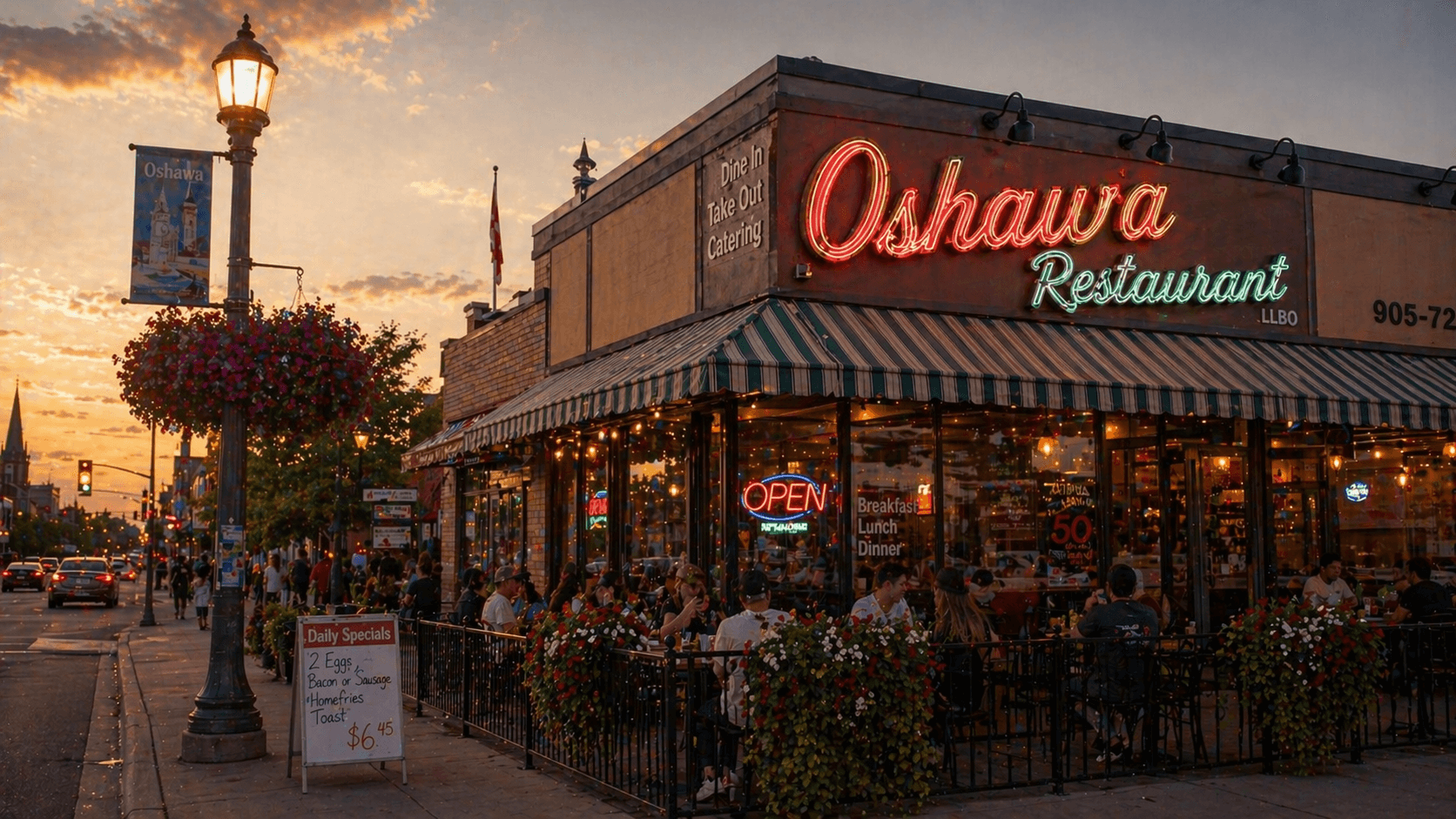
The Oshawa restaurant landscape right now
Oshawa's restaurant activity clusters around four poles. Downtown Oshawa along King Street is slowly revitalizing, with newer cafes, pubs, and pop-up-style concepts alongside long-standing diners and pizzerias — the Tribute Communities Centre (Oshawa Generals home) anchors evening crowds on game nights. The Ontario Tech University and Durham College area in north Oshawa generates a substantial student-driven food economy (wings, pizza, pho, burritos, late-night). Whitby border along Thickson Road and Taunton Road is chain-heavy. The Lakeshore area around Lakeview Park is residential with limited restaurant density. Overall, chain penetration is high — Mandarin, Kelsey's, Montana's, Swiss Chalet, Lone Star, Boston Pizza dominate family-casual — with indie concepts concentrated downtown and near the universities. Auto industry shifts (GM Oshawa Assembly's 2019 closure and subsequent 2021 partial reopening) continue to shape disposable income patterns.
Oshawa's restaurant competition is chain-heavy with a growing indie layer. Downtown revitalization is slow but real — a handful of ambitious new concepts have opened along King Street in recent years, backed by incubator programs and municipal grants. The student market is price-sensitive and loyal to whoever delivers fast on Thursday nights. SkipTheDishes dominates student delivery. Google reviews move covers, but Instagram matters less here than in Toronto or Markham — the student demo uses TikTok and direct word-of-mouth. Staff retention is easier than in Toronto — wage pressure is lower — but seasonal layoffs are the rhythm for student-dependent venues.
Local challenges
- Summer student exodus creates a 4-month cover cliff for north Oshawa venues
- Chain saturation along Thickson and Taunton limits indie foot traffic in that trade area
- Price sensitivity in the student and working-class customer base caps menu pricing
- Downtown revitalization is real but still fragile — foot traffic inconsistent shift-to-shift
- SkipTheDishes commissions on low-ticket student delivery orders eat margin aggressively
Local opportunities
- Student return in September drives an 8-month runway of predictable Thursday-Saturday demand
- Autofest weekend can deliver 3 to 5 percent of annual revenue in four days — plan aggressively
- Oshawa Generals game nights are a repeatable 34-night revenue stream for downtown pubs
- Downtown King Street rent is dramatically lower than any other GTA city — room for ambitious concepts
- Military and veteran-community dining on Remembrance Day and Nov 11 week outperforms GTA baseline
How the seasons and cultural calendar shape sales
Oshawa's calendar is driven as much by the university term as by weather. September through April is peak — students returning to residence and off-campus housing fill wing bars, pizzerias, burrito spots, and late-night takeout from Thursday through Saturday. May through August is genuinely quiet — student-reliant venues lose 50 to 70 percent of covers. Autofest (late July or early August) is a car-enthusiast festival that attracts 250,000 visitors over four days — functionally the single largest tourism event in Durham Region, and downtown restaurants see Burlington-scale spikes. Peony Festival in early June at the botanical gardens draws a quieter but steady weekend crowd. Remembrance Day is observed more intensely here than in most GTA cities — Oshawa has deep military roots — and Christmas is subdued as students travel home. Oshawa Generals OHL home games (roughly 34 per season, September through April) reliably fill downtown pubs.
8 ways to grow restaurant sales in Oshawa
These are the tactics that actually move covers, ordered from highest-impact to quietest-but-compounding. A few of the steps below are tuned specifically to Oshawa — the others are the standard independent-restaurant playbook that works city-wide.
- 1
Put a real digital menu on every table
A PDF behind a QR code is not a digital menu — guests bounce in three seconds. A proper digital menu loads in under two seconds on mobile, shows photos for hero items, and lets you mark a dish sold-out in one tap. Whatever platform you choose, test the menu on your own phone on cellular data in the dimmest corner of the venue; if it is slow there, it is slow everywhere.
- 2
Replace static QR with NFC tags on every table
QR codes work, but their friction — open camera, aim, tap notification — caps adoption well below what a tap achieves. NFC is one action with no app; every iPhone from 2016 and virtually every Android from the last decade reads it natively. Expect meaningful engagement lift on the same menu content, especially in full-service venues where guests already have a printed menu competing for attention.
- 3
Capture phone numbers from every table
The single most valuable asset a restaurant can build is a permission-based SMS list. Put NFC tags on the bill folder with a 'get our next special' opt-in. A 2,000-person list built over six months is worth more than any paid ad channel you can run — especially for seasonal reactivation, event weekends, and quiet Tuesdays.
- 4
Add tap-to-call-waiter and tap-to-request-bill
Guests dislike flagging down a server for basic requests — water, bill, extra napkins. An NFC tag on each table that routes to the assigned waiter's phone via push notification removes the awkward wave-and-wait. Table-turn speed tends to climb, and service perception improves — a quiet win that shows up in tips before it shows up in reviews.
- 5
Update your menu instantly when items sell out or prices change
86-ing a dish mid-service should take 3 seconds from your phone, not a staff-wide ticket and a pen-struck printed menu. A dashboard-driven digital menu lets you toggle availability, adjust prices, and roll in specials without reprinting anything — and without the guest awkwardly ordering something you ran out of at 7:30.
- 6
Run geo-targeted SMS blasts around events and weather
A Thursday-night 'patio is open and the sun is out' SMS to 800 local opt-ins outperforms a full week of Instagram ads for most independents. Same for game-night blasts within 2 km of Scotiabank Arena, or post-concert reactivation after Budweiser Stage shows. Your SMS list plus an event-calendar habit is the highest-ROI marketing channel most restaurants never actually build.
- 7
Run a 'first-class schedule' student SMS campaign in late August
Ontario Tech and Durham College students move in the last week of August. A restaurant near campus that captures phone numbers during September frosh week and blasts a 'Thursday special' SMS every week through April turns the September list into 8 months of predictable Thursday-Saturday revenue. One well-built list is worth more than a full year of Instagram ads.
- 8
Build a downtown game-night playbook around Oshawa Generals home games
The Tribute Communities Centre hosts 34 regular-season home games between September and April. Downtown pubs within three blocks should run a pre-game NFC lead-capture flow and SMS a 'game night 2-hour-before-puck-drop reservation link' to regulars. Restaurants that work this schedule see 30 to 50 percent cover lift on game nights — a repeatable revenue pattern that no chain is marketing against.
Playing the Oshawa calendar
Every Oshawa restaurant year has a handful of days that deliver outsized revenue. Here is how to actually work them rather than let them wash over you.
- 1
Autofest — Late July or early August, four days
Downtown restaurants see 250k-visitor traffic over four days. Pre-book parties of 6+ one week out and deploy NFC lead-capture at sidewalk sandwich boards for walk-in conversion.
- 2
Peony Festival — Early June, Oshawa Valley Botanical Gardens
Brunch cafes within 3 km see weekend bumps. Capture phone numbers from garden-visitor walk-ins for reactivation.
- 3
Oshawa Generals home games — ~34 games, September through April
Tribute Communities Centre crowd fills downtown pubs on game nights. SMS regulars with 'game-night special' 2 hours before puck drop.
- 4
Fiesta Week (Oshawa) — Mid-June
Multicultural pavilion festival with heritage-culture booths. Smaller than Carassauga but a real lead-capture moment.
- 5
Student move-in weekend — Early September
Two weekends of family-plus-student traffic — the student's parents are paying. Average ticket runs 50 percent above baseline.
Neighbourhood-by-neighbourhood
Tactics that work downtown often misfire in a plaza, and vice versa. The micro- markets below drive different dayparts, ticket sizes, and marketing channels.
Downtown Oshawa (King Street)
Slow-revitalizing historic core — Tribute Centre game-night crowds, newer pubs and cafes, long-standing pizzerias.
North Oshawa (Ontario Tech / Durham College)
Student-driven — wings, pizza, pho, burritos, late-night, price-sensitive.
Thickson / Taunton (Whitby border)
Chain dominance — Mandarin, Kelsey's, Montana's, strip-mall family casual.
Lakeshore & Lakeview Park
Residential, limited restaurant density, summer park-traffic brunch pockets.
Ritson & Rossland corridor
Suburban plaza dining, growing South Asian and Caribbean, delivery-heavy.
Running this playbook in Oshawa?
If you'd rather not stitch NFC hardware, menu software, and analytics from three different vendors, see how Tappflow's restaurant platform bundles them.
Frequently asked questions about restaurants in Oshawa
For the right operator, yes — rents are dramatically lower than any other GTA city, municipal revitalization grants are meaningful, and the student and game-night demand layers create real foot traffic. The business risk is summer: May through August is genuinely quiet. Build an SMS list aggressively during September-to-April peak season so you can run reactivation campaigns through the summer trough instead of bleeding cash.
Student-reliant venues run a compressed Thursday-Sunday revenue week. Late-night hours (10 p.m. to 2 a.m.) drive a disproportionate share of orders, especially on delivery. NFC table ordering is especially valuable at student-heavy venues because students expect to order without flagging a server — the tech-first expectation is baked in. Budget for a 4-month seasonal adjustment in May through August when the population effectively halves.
A typical 40-seat restaurant takes about an afternoon. You receive pre-programmed tags, stick one to each table (or under the lip), confirm each is bound to the correct table in your dashboard, and you are live. There is no app for guests to install — they tap their phone and the menu opens instantly.
On every iPhone from the iPhone 7 (2016) forward, and on virtually every Android phone from the last decade. iPhone XS and newer read tags in the background with no app open — just tap and the menu opens. For the rare edge case, most tag cards also carry a printed QR as a fallback so nobody is excluded.
Software sits in the $0–$50/month range for most single-location venues in 2026; Tappflow specifically has a free tier that covers the core digital menu, with paid tiers when you need more menus, languages, or SMS volume. Hardware is a one-time purchase — NFC tags are durable for years of daily tapping, so spread across the tables and a few years of life, the per-tap cost is negligible.
Keep reading
How to Create a Digital Menu for Your Restaurant (Step-by-Step Guide 2026)
Everything you need to launch a working digital menu — from choosing between QR and NFC access to AI menu import, 44+ language translations, and going live for free in an afternoon.
NFC vs QR Codes for Restaurants: Which Actually Works Better?
Cost, friction, analytics, and durability — a no-hype breakdown of where NFC beats QR and where QR still has a place at the table.