The playbook below applies to any tools you run — POS, menu software, marketing stack, whatever. Where a specific tool makes a tactic easier to execute, we name it; Tappflow's restaurant platform happens to cover several of the steps in one place.
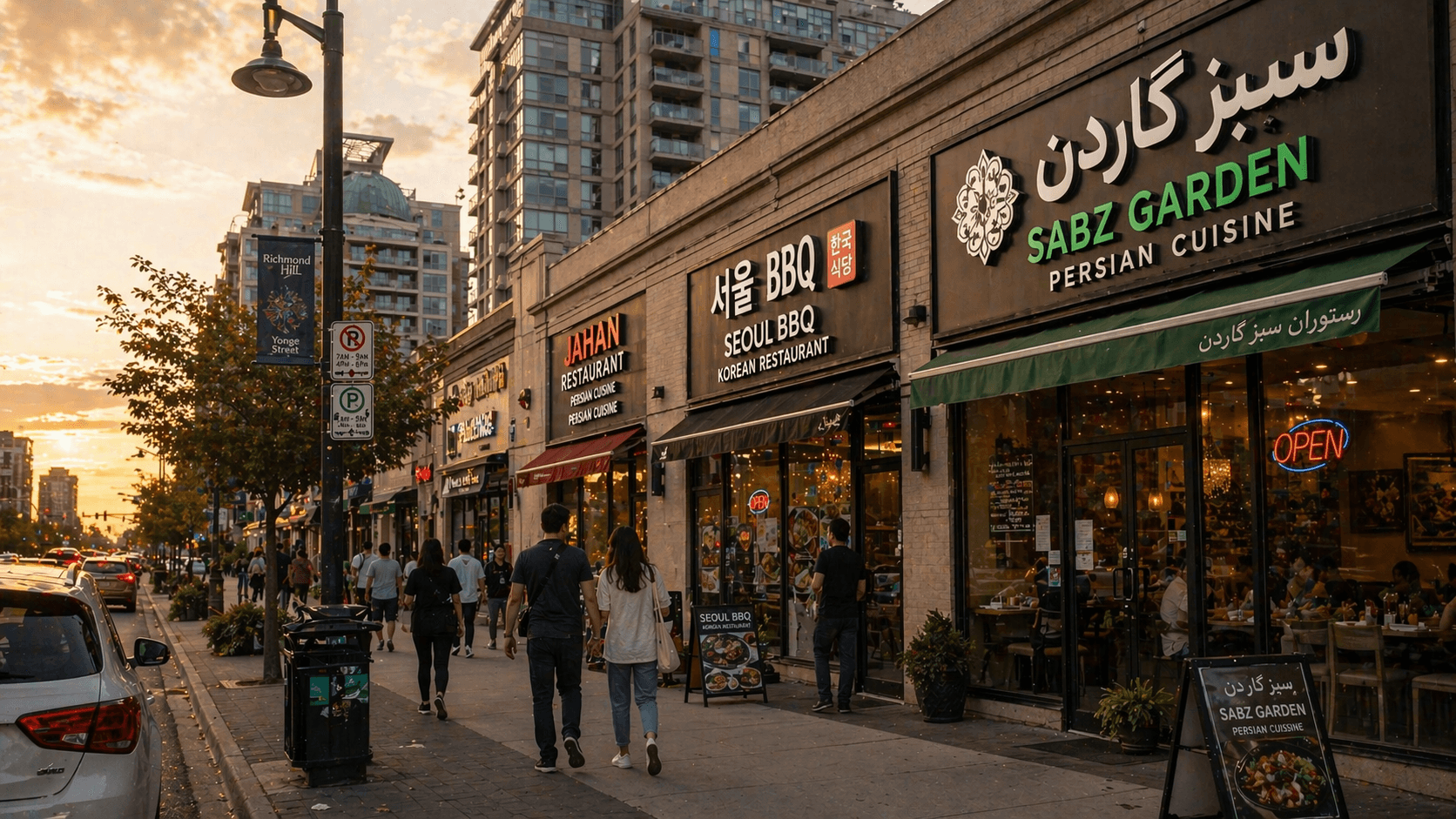
The Richmond Hill restaurant landscape right now
Richmond Hill's restaurant scene runs up Yonge Street for nearly seven kilometres, with real density between Highway 7 and 19th Avenue. The Persian restaurant cluster — dozens of kebab halls, tea houses, bakeries, and ice cream parlours — is anchored around Elgin Mills and Major Mackenzie, with Nowruz catering pulling GTA-wide traffic in March. A separate Chinese restaurant cluster (Cantonese, Taiwanese, Shanghainese) overlaps with Markham's market and competes on the same Xiaohongshu and WeChat channels. Korean BBQ has grown rapidly near Bayview and 16th. Mill Pond Park and the historic village core hold a smaller set of European-Canadian destination restaurants. Richmond Hill is car-first like most of the 905, with virtually all dining happening in plazas off Yonge or side-street strips — street-front walk-ins exist in pockets like Mill Pond but are not the city's traffic pattern.
Richmond Hill's Persian restaurant cluster is uniquely concentrated — within a 2-kilometre stretch of Yonge, a diner can find over 25 Persian kebab houses, bakeries, and tea houses. Competition is intense and largely family-network-driven — Instagram and Telegram are the dominant discovery channels, with word-of-mouth inside Iranian-Canadian networks moving covers faster than any paid ad. The Chinese restaurant cluster competes head-to-head with Markham's; regulars cross-shop between the two cities for specific dishes. Korean BBQ venues compete on all-you-can-eat pricing and late-night hours. Canadian-chain penetration is lower than in Vaughan or Mississauga.
Local challenges
- Persian corridor has 25+ direct competitors within 2 km — margin on kebabs is already thin
- Instagram and Telegram drive Persian-Canadian discovery — owners without those channels lose new-diner trial
- Chinese restaurant cluster cross-shops with Markham, splitting loyalty weekly
- Yonge street-parking and plaza-lot congestion during Nowruz is a known traffic problem
- Staff recruitment for Farsi-speaking servers during Nowruz is extremely tight
Local opportunities
- Nowruz catering pre-orders can drive a month's revenue in two weeks — NFC order pages are the scalable answer
- Persian tea house scene is still growing and underserved in English-speaking marketing channels
- Late-night dessert and ice cream runs (10 p.m. to midnight) are a real daypart in the Persian corridor
- Corporate lunch catering around Yonge corridor offices is underserved by most Persian kitchens
- Bridging Persian and Afghan menus for family-style catering captures a broader Middle Eastern wedding market
How the seasons and cultural calendar shape sales
Nowruz — Persian New Year, roughly March 20 — is the restaurant year's biggest single week for the Yonge Street Persian cluster. Haft-sin table bookings and family-of-10 reservations fill kebab halls and banquet spots, and catering for home celebrations runs at industrial scale. Ramadan (March or April) brings compressed iftar service for the Muslim Iranian and Afghan community. Lunar New Year is meaningful for the Chinese restaurant corridor but smaller than in Markham. Summer patios along Yonge — where zoning allows — boost covers for the small subset of restaurants with outdoor space. Winter is quiet except for the Nowruz window; January and February are the slowest stretch of the year outside Persian catering pre-orders. Mill Pond Festival in late May drives heritage-core restaurant traffic.
8 ways to grow restaurant sales in Richmond Hill
These are the tactics that actually move covers, ordered from highest-impact to quietest-but-compounding. A few of the steps below are tuned specifically to Richmond Hill — the others are the standard independent-restaurant playbook that works city-wide.
- 1
Put a real digital menu on every table
A PDF behind a QR code is not a digital menu — guests bounce in three seconds. A proper digital menu loads in under two seconds on mobile, shows photos for hero items, and lets you mark a dish sold-out in one tap. Whatever platform you choose, test the menu on your own phone on cellular data in the dimmest corner of the venue; if it is slow there, it is slow everywhere.
- 2
Replace static QR with NFC tags on every table
QR codes work, but their friction — open camera, aim, tap notification — caps adoption well below what a tap achieves. NFC is one action with no app; every iPhone from 2016 and virtually every Android from the last decade reads it natively. Expect meaningful engagement lift on the same menu content, especially in full-service venues where guests already have a printed menu competing for attention.
- 3
Capture phone numbers from every table
The single most valuable asset a restaurant can build is a permission-based SMS list. Put NFC tags on the bill folder with a 'get our next special' opt-in. A 2,000-person list built over six months is worth more than any paid ad channel you can run — especially for seasonal reactivation, event weekends, and quiet Tuesdays.
- 4
Add tap-to-call-waiter and tap-to-request-bill
Guests dislike flagging down a server for basic requests — water, bill, extra napkins. An NFC tag on each table that routes to the assigned waiter's phone via push notification removes the awkward wave-and-wait. Table-turn speed tends to climb, and service perception improves — a quiet win that shows up in tips before it shows up in reviews.
- 5
Update your menu instantly when items sell out or prices change
86-ing a dish mid-service should take 3 seconds from your phone, not a staff-wide ticket and a pen-struck printed menu. A dashboard-driven digital menu lets you toggle availability, adjust prices, and roll in specials without reprinting anything — and without the guest awkwardly ordering something you ran out of at 7:30.
- 6
Run geo-targeted SMS blasts around events and weather
A Thursday-night 'patio is open and the sun is out' SMS to 800 local opt-ins outperforms a full week of Instagram ads for most independents. Same for game-night blasts within 2 km of Scotiabank Arena, or post-concert reactivation after Budweiser Stage shows. Your SMS list plus an event-calendar habit is the highest-ROI marketing channel most restaurants never actually build.
- 7
Build a Nowruz catering pre-order page 30 days in advance
Nowruz catering (haft-sin spreads, family feast packages) is the single largest revenue event for Persian kitchens in the GTA. An NFC tag by the hostess stand and another at the bakery counter that opens a pre-order page — with deposits, head counts, and pickup windows — converts walk-in interest at a dramatically higher rate than 'call us to ask.'
- 8
Run a late-night dessert and tea SMS blast
The Yonge Street Persian corridor supports a real 10 p.m. to midnight dessert daypart that most operators leave on the table. An SMS blast to a list built from NFC bill-folder taps (opt-in during dinner, arrive for ice cream two hours later) fills 20 to 30 percent of the empty late-seat capacity.
Playing the Richmond Hill calendar
Every Richmond Hill restaurant year has a handful of days that deliver outsized revenue. Here is how to actually work them rather than let them wash over you.
- 1
Nowruz (Persian New Year) — March 20 and the two weeks around it
Persian restaurants run pre-order catering at industrial scale. NFC-driven catering order pages for haft-sin and family feast packages are the single biggest revenue lever for the year.
- 2
Ramadan iftar window — ~29 nights in March or April each year
Iranian, Afghan, and Pakistani restaurants should pre-book iftar parties of 6+ and push daily iftar-time reminders via SMS.
- 3
Mill Pond Festival — Late May
Mill Pond Park draws heritage-village crowds. Small restaurants nearby can use NFC lead-capture at booths to build a local list.
- 4
Mid-Autumn Festival — Mid-September to early October
Chinese restaurants compete with Markham — differentiate with a pre-order mooncake NFC flow and in-house moon-cake tasting events.
- 5
Remembrance Day quiet window — Early to mid November
The entire city slows noticeably for a week. Lean into reactivation SMS with 'come back this week, here is a $10 credit' — uplift is 4 to 6 percent on dormant regulars.
Neighbourhood-by-neighbourhood
Tactics that work downtown often misfire in a plaza, and vice versa. The micro- markets below drive different dayparts, ticket sizes, and marketing channels.
Yonge at Elgin Mills & Major Mackenzie
Persian-Canadian heartland — kebab halls, tea houses, ice cream, Nowruz catering.
Bayview & 16th / Bayview Hill
Chinese, Korean BBQ, sushi — plaza-driven, competing with Markham.
Oak Ridges & Jefferson
Newer family suburbs, casual dining plazas, growing multicultural mix.
Mill Pond & Historic Village
Heritage core — small-town dining, pubs, seasonal patios.
Richvale / Yonge south of Highway 7
Older suburban strip, diners, chain pockets, cross-border spillover from Thornhill.
Running this playbook in Richmond Hill?
If you'd rather not stitch NFC hardware, menu software, and analytics from three different vendors, see how Tappflow's restaurant platform bundles them.
Frequently asked questions about restaurants in Richmond Hill
Yes. Richmond Hill's Persian restaurant density — measured as kebab halls and catering kitchens per capita — is higher than any other North American city outside a few specific Los Angeles neighbourhoods. Growth tactics that lean on this concentration (catering pre-orders for a radius of 20 km, Nowruz-specific promotion, Farsi-language service) are not meaningful in Thornhill or downtown Toronto at the same scale.
The main bridge is a tight, well-photographed Instagram presence with English captions, plus a menu that highlights familiar entry points (grilled chicken kebab, saffron rice, flatbread) for first-time non-Iranian diners. A bilingual NFC menu and a low-friction tap-to-reserve flow removes two of the three barriers non-regulars typically hit. The third — knowing which dish to order first — is solved by a 'chef's pick starter combo' featured at the top of the menu.
A typical 40-seat restaurant takes about an afternoon. You receive pre-programmed tags, stick one to each table (or under the lip), confirm each is bound to the correct table in your dashboard, and you are live. There is no app for guests to install — they tap their phone and the menu opens instantly.
On every iPhone from the iPhone 7 (2016) forward, and on virtually every Android phone from the last decade. iPhone XS and newer read tags in the background with no app open — just tap and the menu opens. For the rare edge case, most tag cards also carry a printed QR as a fallback so nobody is excluded.
Software sits in the $0–$50/month range for most single-location venues in 2026; Tappflow specifically has a free tier that covers the core digital menu, with paid tiers when you need more menus, languages, or SMS volume. Hardware is a one-time purchase — NFC tags are durable for years of daily tapping, so spread across the tables and a few years of life, the per-tap cost is negligible.
Keep reading
How to Create a Digital Menu for Your Restaurant (Step-by-Step Guide 2026)
Everything you need to launch a working digital menu — from choosing between QR and NFC access to AI menu import, 44+ language translations, and going live for free in an afternoon.
NFC vs QR Codes for Restaurants: Which Actually Works Better?
Cost, friction, analytics, and durability — a no-hype breakdown of where NFC beats QR and where QR still has a place at the table.